
光遗传学是一项注定取得诺贝尔奖的技术。而华人科学家潘卓华(中国科大774校友)可能是光遗传学的创始人却被遗忘了。

光遗传学被认为是数十年来神经科学的最大突破,为治愈帕金森、盲人和慢性病提供了可能。《知识分子》也曾于2016年5月7日撰文《光遗传学:一项注定要得诺贝尔奖的技术》。然而,它的创始人又是谁呢?近日,美国健康医疗专业媒体《STAT》采访了这位可能是光遗传学第一人的科学家----美国韦恩州立大学教授潘卓华(中国科学技术大学774校友)。
很多神经生物学家没听说过潘卓华,中国人不知道潘卓华,可惜的是中国科大人也不知道潘卓华----中国科大新创校友基金会在2016年4月3日曾以《转基因人?绿藻基因转人体治失明!》为题,介绍过潘卓华及其技术应用,同样波澜不惊,未能引起校友的关注。
早在2004年2月,潘卓华成功将光敏通道蛋白(Channelrhodopsin)添加到视网膜神经元中,通过光照改变细胞活性。为此,美国国立卫生研究院(NIH)授予他30万美元的资助,并称赞:这是一项是史无前例的革命性技术。
潘卓华并不知道,他当时正与世界各地多家实验室赛跑。谁料本是最早完成实验的潘卓华,先后在《Nature》《Nature Neuroscience》《Journal of Neuroscience》等期刊的文章投递屡屡遭拒,并未引起重视。杂志编辑回应称其文章应用狭窄,只解释了光敏通道蛋白在恢复视觉上的应用,而非普遍应用。也有人说,潘卓华的国别、学校排名等都是被忽视的原因。有人说:他如果来自名校,故事可能不同。
2005年,当相似的成果由美国斯坦福大学的Karl Deisseroth和麻省理工学院的 Ed Boyden发表在《Nature Neuroscience》之后,轰动一时,并被《纽约时报》称为光遗传学史上的重大突破。相较于美国学者获得的高额资金与媒体聚焦,潘卓华则在十年间资助有限仅够维持研究。当《STAT》问对于当年经历的看法时,他称赞了美国学者,说只是如果自己的文章发表更早,他们就能获得更多的认可了。现在,潘卓华还在从事光遗传学的研究,说:“我的实验室很小,我们的主要兴趣在于让人们重获光明。”
大写的“悲剧”和不公平?
科学网博主、新加坡国立大学副教授张洛欣为潘卓华这位小人物鸣不平。他将潘卓华的成果总结为:
早在ChR2 2003年9月报道发表后。2004年2月潘卓华就发现ChR2 能激活RGC(retinal ganglion cell )。潘卓华申请了美国NIH(国立医学研究院)30万美元基金。2004年8月他用病毒实现了在大鼠眼睛里的在体表达,并且能被光激活。
伟大的科学发现之后是一系列悲剧的开始:
2004 年11月25日他向著名的《自然》(Nature)被拒。编辑建议他转投更细分专业领域的《Nature Neuroscience》杂志。
接着转投Nature Neuroscience也被拒!
2005年初,他的成果再投Journal of Neuroscience,再次被拒。
2005年5月他在IVOS( Association for Research in Vision and Opthamology)会议上介绍了自己的成果。 他的讲座只持续了15分钟。
2005年8月 Nature Neuroscience 发表了Edward Boyden 和 Karl Deisseroth 以及张峰的optogenetics文章。
2006年4月他的文章才终于被Neuron接受。
都被遗忘:在中国与科大
2005年,当相似的成果由美国斯坦福大学的Karl Deisseroth和麻省理工学院的 Ed Boyden发表在《Nature Neuroscience》之后,轰动一时,并被《纽约时报》称为光遗传学史上的重大突破。
2005年至今,Deisseroth获得1800万美元的基金;Boyden拿到的超过1000万美元。他们都成为科学明星 多次获奖,暴露在聚光灯下,名利双收。潘卓华只在过去十年拿到了300万美元----STAT News说这只够 勉强维持运营。
对于这一切,潘卓华心静如水。当《STAT》问对于当年经历的看法时,他坚持称赞了美国学者“毫无疑问,他们做了杰出的工作”。他也平静的说:我也很幸运。虽然如果自己的文章发表更早,故事可能不同。现在,潘卓华还在从事光遗传学的研究,说:“我的实验室很小,我们的主要兴趣在于让人们重获光明。”
潘卓华在哪儿都不为人注意,更有趣的是,或许一大半中国科大774同班同学都不记得他。中国科大新创校友基金会联络了三位科大774同班同学。 另一位男生对这位四五年的同学抱歉的说“没有记忆”。另一位博闻强记的女生说“记不清了。我印象中潘是一个话很少、少年时就很老成的人,理论物理专业。你请万东查查,774家谱他最门儿清。”
她笑称“我没有评价了,整个大学期间我没与他说过一句话。我想774的女生他能说出名字的不会超过5个。”
原物理学院院长刘万东教授(774)是唯一记得潘卓华的人“潘卓华是金华人,父亲在金华一中工作,他妹妹都毕业于该校。”当新创基金会请刘万东教授给出他脑海里所有的潘卓华的记忆时。这位文彩极好的 教授说“老实,不善交往。”

这很正常:中国科大774科学家璀璨若繁星,有两位中科院院士赵政国、谢心澄;五位美国物理学会会士周冰、陈剑平、何小刚、赵政国、谢心澄。潘卓华低调的隐身在他小小的实验室,醉心于光遗传学研究。----他是纯粹的科学人。
潘卓华低调的隐身在他小小的实验室,醉心于光遗传学研究。----他是纯粹的科学人。
光遗传学先驱潘卓华教授简介

潘卓华,1978年3月从浙江金华一中进入中国科学技术大学近代物理系学习(774),1982年获得学士学位。1984年获中国科学院生物物理所硕士;1990年获纽约州立大学布法罗分校博士学位。随后担任美国韦恩州立大学医学院解刨学和细胞生物学系 教授,2011年出任该校Kresge眼科研究所眼科学Edward T. and Ellen K. Dryer讲席教授。潘教授也是RetroSense Therapeutics首席科学家。
2001年获得韦恩州立大学医学院杰出教授研究奖;2004年获得该校Career Development Chair奖。
谁是起底光遗传学之父的STAT News?
STAT News由Boston Globe Media创办,与波士顿环球报隶属于同一集团。
STAT News是一家立足快速、深度与艰深的科技媒体,侧重于科学与实验室成果,医院与生物科技报道。STAT News网站称:我们解剖关键发现,直面争议话题,戳穿炒作。
新闻来源:英文新闻来自STAT,中文新闻由中国科大新创校友基金会独家发布。欢迎转载,必须标明出处。作者为徐瑞君(新创基金会实习生,毕业于青年政治学院新闻系),编辑李惠玉(9507)、刘志峰(9500)。
STAT News9月1日的报道见下文。
He may have invented one of neuroscience’s biggest advances. But you’ve never heard of him
Zhuo-Hua Pan in his lab at Wayne State University in Detroit.
The next revolution in medicine just might come from a new lab technique that makes neurons sensitive to light. The technique, called optogenetics, is one of the biggest breakthroughs in neuroscience in decades. It has the potential to cure blindness, treat Parkinson’s disease, and relieve chronic pain. Moreover, it’s become widely used to probe the workings of animals’ brains in the lab, leading to breakthroughs in scientists’ understanding of things like sleep, addiction, and sensation.
So it’s not surprising that the two Americans hailed as inventors of optogenetics are rock stars in the science world. Karl Deisseroth at Stanford University and Ed Boyden at the Massachusetts Institute of Technology have collected tens of millions in grants and won millions in prize money in recent years. They’ve stocked their labs with the best equipment and the brightest minds. They’ve been lauded in the media and celebrated at conferences around the world. They’re considered all but certain to win a Nobel Prize.
There’s only one problem with this story:
It just may be that Zhuo-Hua Pan invented optogenetics first.
Even many neuroscientists have never heard of Pan.
Pan, 60, is a vision scientist at Wayne State University in Detroit who began his research career in his home country of China. He moved to the United States in the 1980s to pursue his PhD and never left. He wears wire-rimmed glasses over a broad nose framed by smile-lines in his cheeks. His colleagues describe him as a pure scientist: modest, dedicated, careful.
Pan was driven by a desire to cure blindness. In the early 2000s, he imagined that putting a light-sensitive protein into the eye could restore vision in the blind ― compensating for the death of rods and cones by making other cells light-sensitive.
That was the germ of the idea of optogenetics ― taking a protein that converts light into electrical activity and putting it into neurons. That way, scientists could shine light and stimulate the neurons remotely, allowing them to manipulate brain circuits. Others had experimented with trying to make neurons light-sensitive before, but those strategies hadn’t caught on because they lacked the right light-sensitive protein.
That all changed with the first molecular description of channelrhodopsin, published in 2003.
Channelrhodopsin, a protein made by green algae, responds to light by pumping ions into cells, which helps the algae search out sunlight.
That “was one of the most exciting things in my life,” Pan said. “I thought, wow! This is the molecule we are looking for. This is the light sensor we are looking for.”
By February 2004, he was trying channelrhodopsin out in ganglion cells ― the neurons in our eyes that connect directly to the brain ― that he had cultured in a dish. They became electrically active in response to light. Over the moon with excitement, Pan applied for a grant from the National Institutes of Health. The NIH awarded him $300,000, with the comment that his research was “quite an unprecedented, highly innovative proposal, bordering on the unknown.”
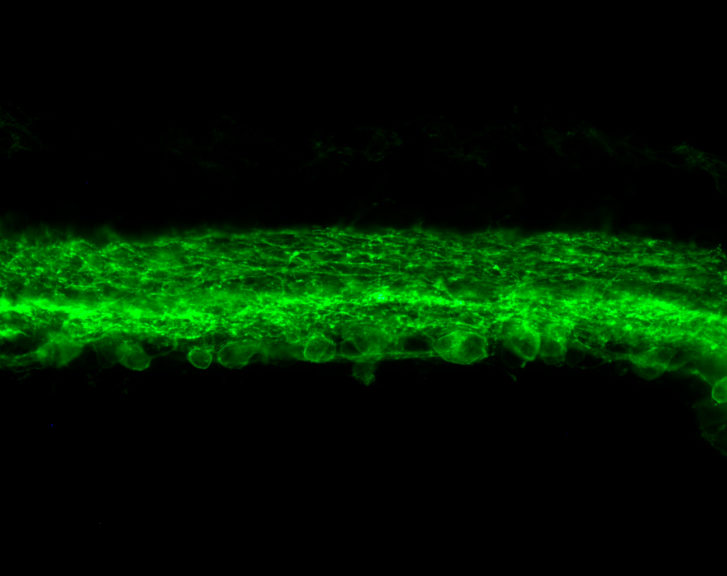
A side view of a blind mouse’s retina containing channelrhodopsin. The round structures at the bottom are the cell bodies of the neurons.
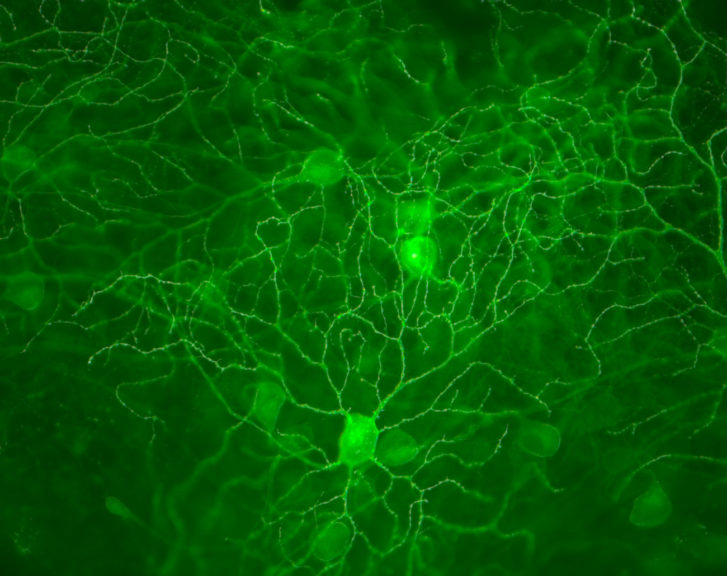
A close-up of the mouse retina showing neurons with channelrhodopsin and green fluorescent protein.
Pan didn’t know it at the time but he was racing against research groups across the United States and around the world to put channelrhodopsin into neurons.
Deisseroth and Boyden were working at Stanford, where Deisseroth was finishing a postdoc and Boyden was finishing graduate school. At least two other groups were in the game as well, led by Stefan Herlitze and Lynn Landmesser, who were at Case Western Reserve University at the time, and Hiromu Yawo at Tohoku University in Japan.
And they were by no means the only scientists experimenting with ways to control neurons with light. By 2004, Gero Miesenbock and Richard Kramer had already published articles using other, more complicated molecules for that purpose. But channelrhodopsin was the tool that was about to revolutionize the field.
The Stanford group had been toying with the idea of controlling neurons with light for quite some time. They had also noticed the paper about the discovery of channelrhodopsin. Deisseroth got in touch with the paper’s author, Georg Nagel, in March 2004 and asked if Nagel would collaborate, sharing the channelrhodopsin DNA so Boyden could try it out in neurons. In August 2004, Boyden shined light on a brain neuron in a dish and recorded electrical activity from the channelrhodopsin.
Pan had done the same thing with retina neurons six months earlier. But then he got scooped.
‘We didn’t feel very lucky’
Boyden, who is now a professor at MIT, was surprised when told by STAT that Pan ran the experiment first.
“Wow. Interesting. I didn’t know that,” Boyden said.
“It’s funny to think about how science regards when something is proven,” he added, noting that scientists build on each others’ work, sometimes working together while at other times working in parallel, scrambling onto one another’s shoulders. “There’s both intentional and unintentional teamwork,” he said.
The Stanford press office said Deisseroth was unavailable. In response to questions provided by STAT, spokesman Bruce Goldman wrote that Pan’s study was “a far cry from the use of optogenetics … to open up a new world of precision neuroscience. That’s the potential revealed in Dr. Deisseroth’s widely cited 2005 publication.”
Pan said he might have mentioned the timing of his experiment to Boyden once several years ago, but, Pan said, “I didn’t want to take too much time to talk about this because people feel uncomfortable.”
That sentiment is in keeping with Pan’s wider approach ― diligent, reserved, outside the limelight. Wayne State is a small university not known for its scientific research. Pan had gone to a state school for his PhD, then done mostly obscure research for decades. These things may have contributed to what happened next, when he tried to get his invention out into the world: It wasn’t seen as the big advance it was.
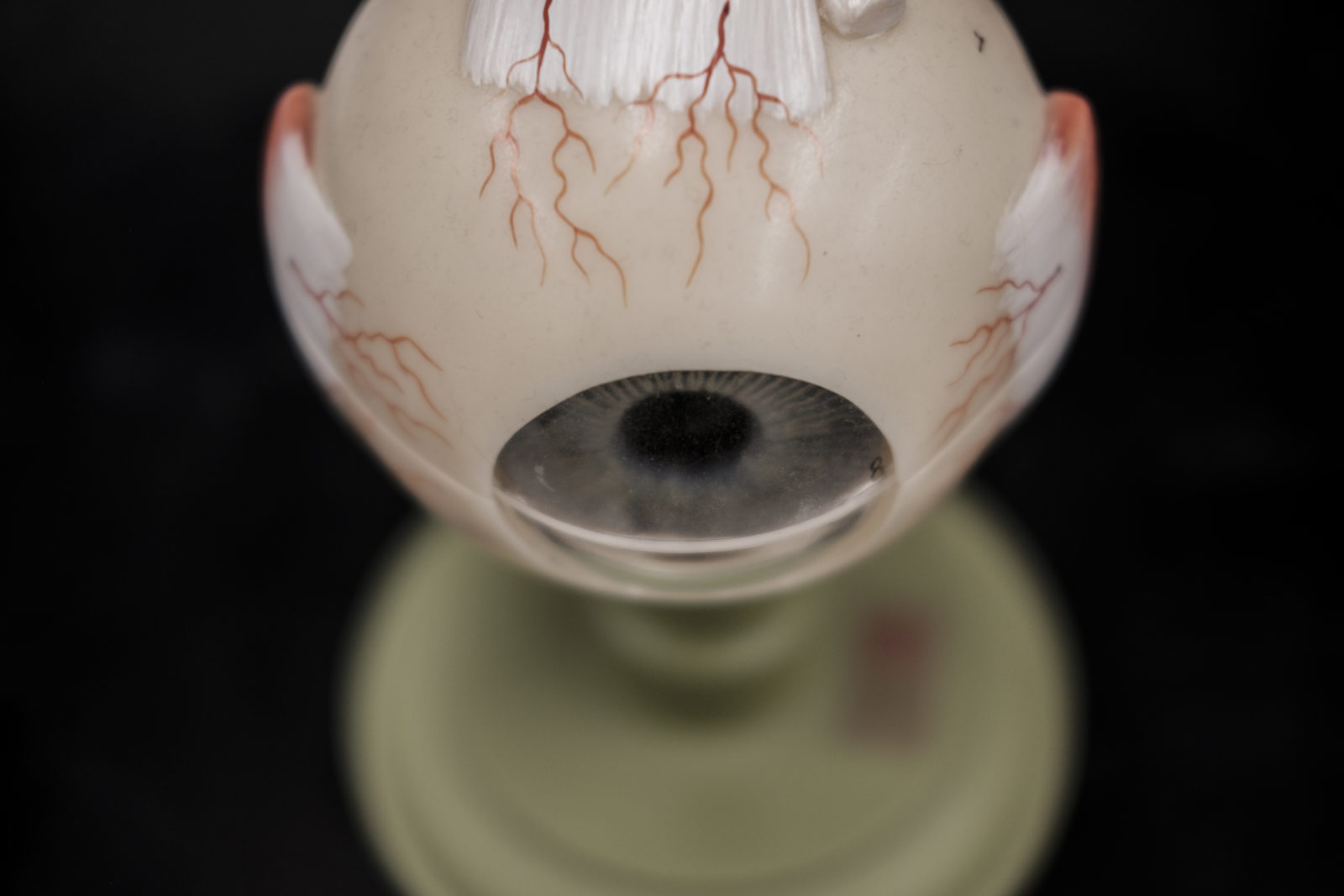
A model of a human eye in Pan’s lab.
Pan spent the summer of 2004 figuring out how to get the channelrhodopsin protein into a living eye. He settled on the idea of using a virus, which could infect cells in the eye and sneak the channelrhodopsin DNA inside. His colleague, Alexander Dizhoor, a professor at Salus University, engineered the channelrhodopsin DNA to add the gene for a protein that fluoresced green under blue light, so they could track where the channelrhodopsin ended up.
In July 2004, Pan dosed his first rat with the virus. About five weeks later, he looked at the retinas to see if it had worked. What he saw was a sea of green ― thousands of ganglion cells had the green protein coupled to channelrhodopsin in their membranes. And when he stuck an electrode in one of those cells and turned on a lamp, the cell responded with a flurry of electrical activity. The channelrhodopsin was working. It was just a first step, but it was a revolutionary step ― indicating that Pan’s method may just be able to restore sight to the blind.
“Everything turned out beautifully,” Pan said.
So Pan and Dizhoor wrote a paper about their work and submitted it to Nature on November 25, 2004, according to the submission letter Pan shared with STAT. The editors at Nature suggested they send it on to a more specialized journal called Nature Neuroscience, which rejected it. Early the next year, Pan sent the paper to the Journal of Neuroscience, where it was reviewed but then again rejected.
Disheartened, Pan set to work revising his paper, and in May 2005 traveled to Fort Lauderdale, Fla. for the Association for Research in Vision and Opthamologyconference, where he described his work using channelrhodopsin in neurons.That single lecture, lasting just 15 minutes, would come to be his clearest stake along the timeline of invention.
It was what came next that would make that stake matter. A few months later, in August of 2005, Nature Neuroscience published a paper about using channelrhodopsin to make neurons sensitive to light. The paper was by Edward Boyden and Karl Deisseroth.
Pan heard the news from a colleague who emailed him the paper. “I felt terrible. I felt terrible,” Pan said, pausing. “We didn’t feel very lucky.”
Met with a shrug
Deisseroth and Boyden’s paper was slightly different than Pan’s. They simply demonstrated that they could use channelrhodopsin to control neurons’ activity in a dish; Pan had waited to publish until he could make it work in a live animal. And Deisseroth and Boyden had shown incredibly precise time control, by turning the light on for just a millisecond. But their technical feat was essentially the same: They had used channelrhodopsin to successfully make neurons in a dish respond to illumination.
The Stanford paper took a little while to take off, but take off it did. The work jump-started both Deisseroth’s and Boyden’s careers, landing them big money grants and talented students for their labs ― Deisseroth at Stanford and Boyden at MIT. The New York Times started writing about Deisseroth’s breakthroughs with optogenetics in 2007, and the citations of the research paper took off exponentially.
By the time Pan finally managed to publish his paper, in Neuron in April 2006, it was mostly met with a shrug. Richard Kramer, a neuroscientist at UC Berkeley who was also studying vision, remembers, “It wasn’t that creative, it was just ‘Oh look, you can put channelrhodopsin in neurons from the brain, you can also put it in neurons from the retina.’ Was it impressive? No.”
Those handful of months seem to have made all the difference.
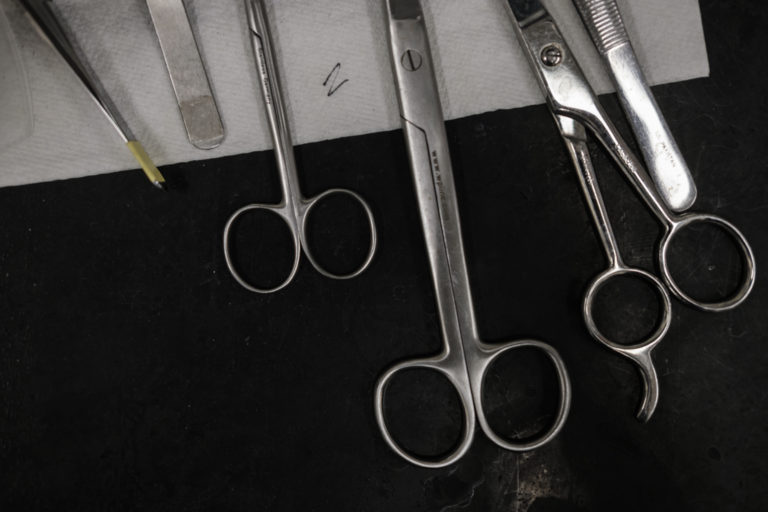
Culture dishes growing bacteria and dissection tools used in Pan’s lab.
Why didn’t Pan’s paper get published first? He may never know the answer. After Boyden’s paper came out, Pan wrote to the editor at Nature Neuroscience asking how they could have rejected his paper but published Boyden’s.
In her response, the editor replied that while the papers were similar, Boyden et al. presented theirs as a new technology rather than as a scientific finding. Pan’s paper, it seemed, was too narrow, only focusing on using channelrhodopsin to restore vision, while Boyden’s paper took the broad view of thinking of channelrhodopsin as a tool for neuroscience in general.
The reviews that other researchers submitted to the Journal of Neuroscience shed some more light on what people thought of Pan’s paper. One reviewer liked it and had some minor suggestions for improvement. The other, in a single long paragraph, said the research was “ambitious” and “very preliminary” and concluded that “there is too little here to entice most neuroscientists.”
In hindsight, Pan’s coauthor Dizhoor can’t help but laugh while reading that. Reviewers would ultimately greenlight an expanded version of Pan’s paper, in 2006, with minimal revisions.
But that hasn’t elevated Pan to the optogenetics pantheon. In terms of publication, he was quite late to the party, with three different groups publishing papers about channelrhodopsin before he did. He didn’t share in two big prizes that recently went to Deisseroth and Boyden, the Brain Prize in 2013 (1 million euros split between six inventors of optogenetics) and the Breakthrough Prize in 2015 ($3 million each to Boyden and Deisseroth).
Since 2005, Deisseroth has been awarded over $18 million in NIH grants for his work on optogenetics, and Boyden has received more than $10 million. Both have other major projects that bring in additional funding to their labs each year. Boyden is a prolific speaker who’s given multiple TED talks; Deisseroth was the subject of an in-depth profile in the New Yorker in 2015.
Pan, on the other hand, has cumulatively received just over $3 million over the past 10 years and holds one NIH grant ― the bare minimum to keep a research program going. Most of the accolades for his work have come from Wayne State University. According to his website, he’s been invited to give a couple of talks ― most recently at a technology show in Russia.
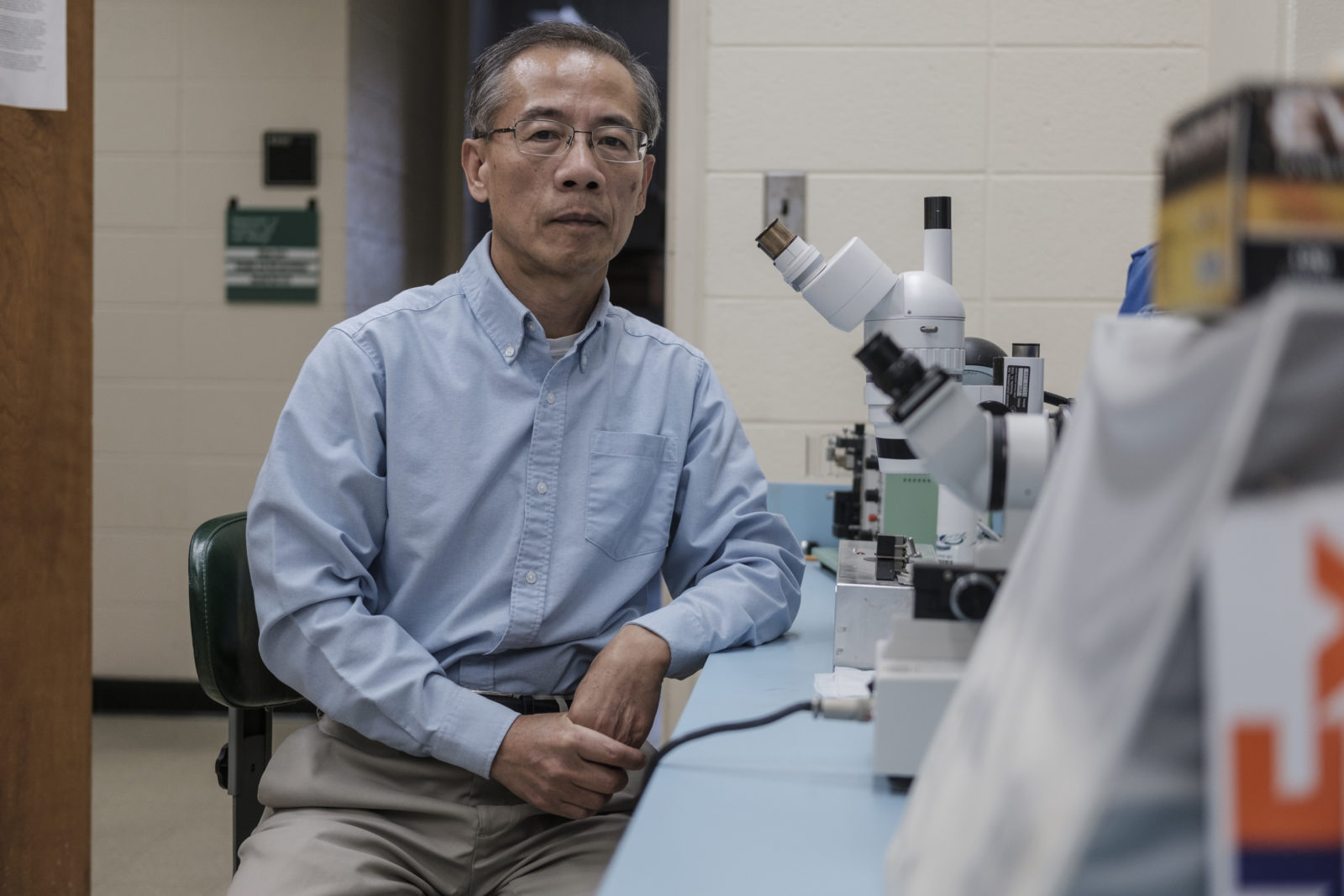
Pan in his lab at Wayne State University, where he continues to work on channelrhodopsin.
Rules of the invention game
The whole saga raises the question of what it means to invent something in science. It’s a question that has plagued scientists in recent years ― including the ongoing CRISPR patent fight ― as research becomes ever more global and the spoils of biotechnology and medical discoveries become ever more valuable.
The answer, it turns out, shifts depending on context.
Fellow academics often consider the first scientists to publish a paper on a technique the discoverers or inventors of that technique.
But that metric can be problematic, as Pan’s experience shows. In a recent essay in the journal eLife, Ronald Vale and Anthony Hyman, two biologists, laid out the problem. They point out that “the delay between the submission of a paper and its publication can range from a few weeks to more than two years,” adding that journals “slow down and create inequities in how knowledge is transferred from the scientist to the worldwide scientific community.”
And reviewers can be biased toward familiar names or prestigious institutions.Blinded review, in which the author’s name is redacted, has been suggested as a way to minimize that effect, but many scientists are skeptical that it would work, since research is often discussed ahead of time at conferences.
Vale and Hyman advocate, instead, for scientists to post drafts of their work on “preprint servers” such as bioRxiv before they submit it to journals. If such a server had been widely used by neuroscientists in 2004, Pan could have posted his rejected findings there, staking his claim.
But whether that would mean he would be on the short list for the Nobel Prize is unclear. Kramer thinks that even if Pan had published on bioRxiv, he’d be shut out because he wasn’t the first to publish a peer-reviewed paper on the technique. That’s what will matter if and when the inventors of optogenetics win the Nobel.
The legal system doesn’t play by quite the same rules. According to an American Bar Association representative specializing in patent law, to prove precedence for a patent in the early 2000s, most of the time you needed to show both “when someone had actually conceived of the invention ― that’s sort of in your mind the lightbulb going off, ‘Aha! I have it!’ ― and when the invention was reduced to practice ― that means you’ve actually done it and you’ve proven that your idea can work.”
By those standards, a discovery happens at the time of its demonstration in the lab, even before it’s been posted on a preprint server.
Then there’s the court of public opinion. Scientists are increasingly public personalities, running Twitter accounts and appearing on late-night talk shows.
“The quality rising to the top is a little more influenced by non-scientific things than it used to be,” said Richard Masland, an emeritus professor at Harvard Medical School, who also holds patents on gene therapy for blindness.
Being at Wayne State University might have meant that Pan didn’t have the resources to get a high-profile paper published. There’s the actual costs of doing high quality of research, but in addition, senior researchers at top universities usually mentor junior professors, reading their work and helping them take it to the next level.
Pan agrees that fact may have put him at a disadvantage compared with scientists at prestigious institutions like MIT or Stanford. “Of course, I cannot prove that with evidence,” he said. And Pan’s modesty and non-native language abilities may have kept him from promoting himself as well as Boyden and Deisseroth did.
“He’s just not as public a speaker and presenter as other people in the field. And this is an important part of the whole game of being able to get out there and sell yourself,” Kramer, the UC Berkeley vision researcher, said.
That publicity can be self-reinforcing. Landmesser, the Case Western professor who worked on channelrhodopsin in the beginning, said, “I think there’s always a tendency [that] whoever gets there first gets more publicity, let’s put it that way.”
A university PR video can spawn a national news article, which spurs someone to think of your name in nominations for a nice cash prize, which leads to some TV appearances. The word “inventor” gets used at some point and before you know it you’re Google’s automatic answer to the question “Who invented optogenetics?”
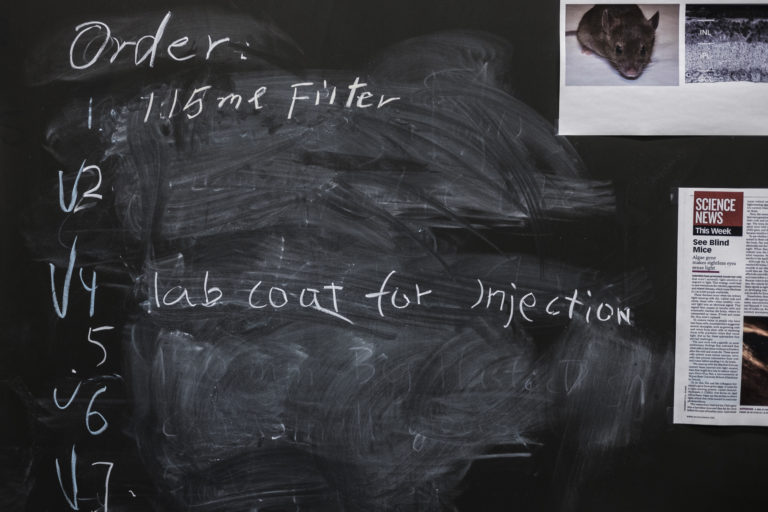
A chalkboard and glassware drying rack in Pan’s lab. He has used channelrhodopsin to help blind mice see.
Ultimately, both Pan and the team of Boyden and Deisseroth won patents for their discoveries.
Pan’s May 2005 lecture threatened to derail the Boyden-Deisseroth patent for a while ― the US patent office rejected it multiple times because Pan’s abstract was published more than a year before they got around to filing.
Eventually, Deisseroth and Boyden signed a document stating that they had invented this method of using channelrhodopsin privately in the lab before Pan’s conference abstract was published. The relevant patent was issued in March 2016, almost 10 years after they filed.
Now, Deisseroth is a cofounder and scientific advisor at Circuit Therapeutics, a company developing a wide range of therapies based on optogenetics, presumably using Deisseroth’s patented inventions. (Circuit Therapeutics declined to comment on specifics of their intellectual property licenses.)
Pan won a patent as well, to use channelrhodopsin to restore vision in the eye. His patent was licensed by RetroSense, which won an award from the Angel Capital Association in 2015. Retrosense ― whose CEO in passing told STAT about Pan’s role in the invention of optogenetics ― began clinical trials this year to put the algae proteins in blind people using gene therapy. It’s the first application of optogenetics in humans and the first time a non-human gene is being used in a gene therapy trial.
Right now, there are blind people in Texas walking around with algae DNA and proteins in their eyes. And that was what Pan was in it for all along. “One thing I still feel glad about is that even right now our clinical study is still ahead of anyone,” Pan said.
But given that there are no gene therapies approved for clinical use in the United States, the road to successfully using optogenetics in humans will likely be a long one. Yang Dan, a professor of neuroscience at UC Berkeley who uses optogenetics to study sleep, isn’t betting on optogenetics cures being in the clinic any time soon. “I believe that these safety checks will take a long, long time,” she said.
As for the invention itself, some scientists say Pan may not have had the big, award-worthy vision that Deisseroth and Boyden had. Stefan Herlitze, one of the others who was scooped for the first publication about channelrhodopsin in neurons, said, “Of course I have to say, Deisseroth and Boyden, they really developed the field further.”
Boyden echoed this. “Karl and I were very interested in the general question of how to control cell types in the brain,” he said. “In recent years, we worked to push these molecules to their logical limits.”
So maybe it doesn’t matter who invented optogenetics, just who has stretched science’s boundaries the furthest.
Asked whether he deserves the recognition that Boyden and Deisseroth have enjoyed, Pan declined to answer. He later told STAT that Deisseroth “also did a very excellent job, no doubt. But he’s also very lucky because if our paper was ahead of him, the story would be different. We would have gotten more credit.”
That is about as much as Pan is willing to say about the way his cards fell. Today he’s still in Detroit. He’s been working on new versions of channelrhodopsin that could be used to cure blindness. “My lab is a very small lab,” Pan said, “We’re mainly interested in trying to restore vision.”
评论 (0)