
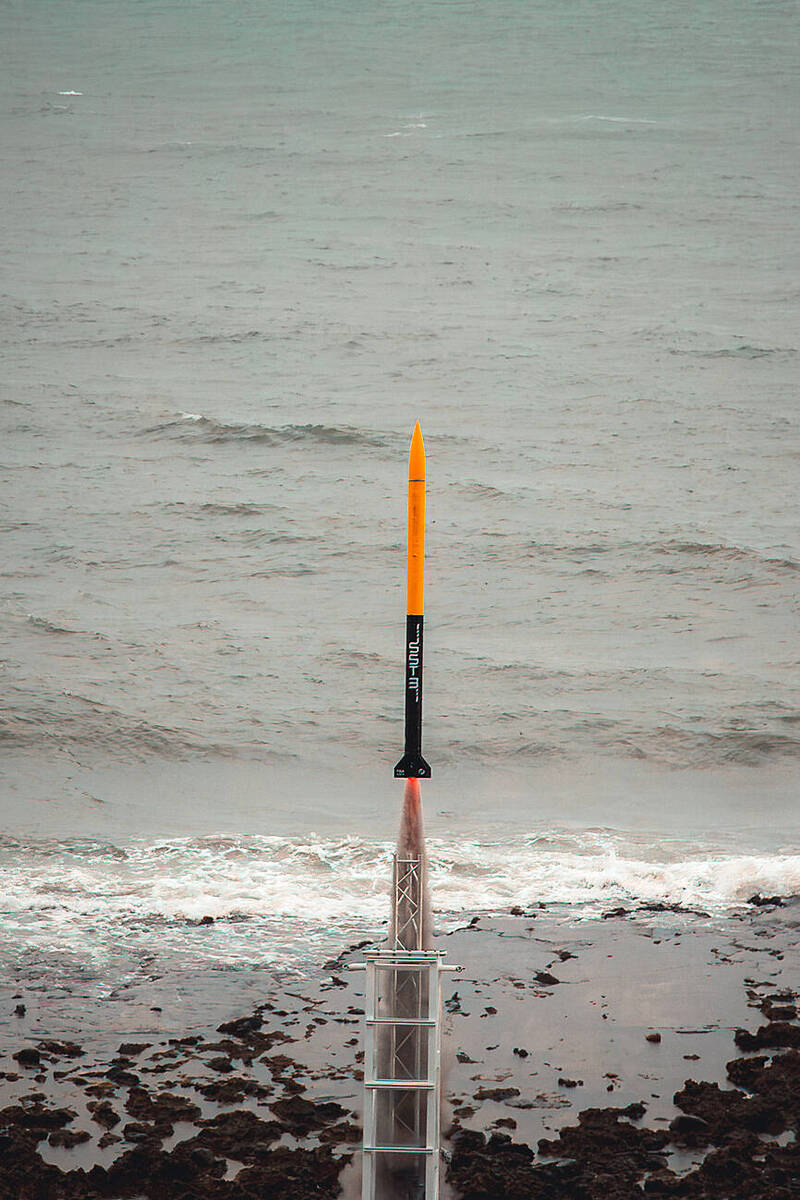
By Yang Yuan-ting and William Hetherington / Staff reporter, with staff writerThe Taiwan Space Agency (TASA) yesterday announced that two research rockets, SST3 and FARCX-1, completed test flights despite heavy rain at the short-term research rocket launch site in Pingtung County’s Syuhai Village (旭海).請繼續往下閱讀...SST3 is the largest solid-propellant sounding rocket launched in Taiwan by an academic team, while FARCX-1 is Taiwan’s first liquid-propellant sounding rocket independently developed and flight-tested by students, TASA said.The tests came two days after TASA launched its first domestically developed sounding rocket, Maraho, on Saturday.SST3 is 3.5m long and reached an altitude of 8.3km, TASA said.The 33-member mission team includes the Advanced Rocket Research Center (ARRC), National Yang Ming Chiao Tung University’s Institute of Space Systems Engineering and, Aerospace Systems and Aerodynamics Research Labs, and National Cheng Kung University’s Department of Mechanical Engineering, and Yang Ming Chiao Tung University’s Formosan Fox student team.The rocket uses a Pioneer-50K RNX solid-fuel propulsion system and reached its maximum altitude 40 seconds after launch. Although its parachute failed to deploy, and the rocket was not recovered, communications were successfully maintained during key stages of the flight.Wei Shih-hsin (魏世昕), an assistant professor at the institute, said SST3 builds on the development of SSTO, which reached 1km in 2024, and SSTT, which targeted 3km last year.For the new rocket, the team increased the target altitude to 9km and verified its propulsion system and structural strength, he said, adding that the team hope to provide more standardized propulsion systems for the future Rocket Taiwan Cup.FARCX-1 uses an independently developed liquid propellant system, with ARRC responsible for designing, manufacturing and ground-testing the engine.The rocket uses highly concentrated hydrogen peroxide as an oxidizer and kerosene as fuel. During the initial test, its propulsion system operated for three seconds, and the rocket reached an altitude of 532m.Liquid rocket technology has a high technical threshold, and the first flight test provided valuable data, Wei said, adding that the team would use system performance analysis to increase the rocket’s energy level and extend its range.新聞來源:TAIPEI TIMES
评论 (0)