
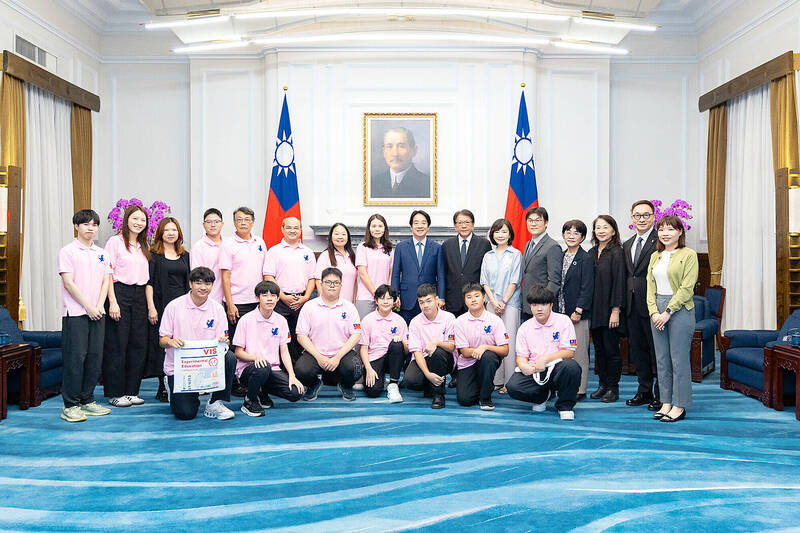
By Esme Yeh / Staff writer, with CNAPresident William Lai’s (賴清德) administration plans to allocate more than NT$40 billion (US$1.26 billion) next year to develop 10 major artificial intelligence (AI) projects, with a goal of training at least 500,000 AI professionals by 2040.請繼續往下閱讀...Lai yesterday met with the VIS Mars robotics team, which represented Taiwan at the FIRST Tech Challenge robotics tournament in Turkey in June. He praised the students for overcoming a major setback when customs detained their competition equipment after they arrived in Turkey.Unable to access their robot, the team collected discarded components and borrowed tools from other teams to assemble a replacement robot before the competition. They won four qualification matches and earned the tournament’s highest match points.Lai said the students’ ability to adapt under pressure reminded him of the fictional character MacGyver.Team captain Ray Shang (商泱瑞) said their greatest strength was not their equipment, but their ability to rethink, adapt and solve problems regardless of the circumstances.Lai said technology education and talent development remain key government priorities.The government launched the AI Talent Ark Project this year to nurture talent through fundamental education, professional development and data-driven approaches. The initiative, together with the 10 major AI projects, aims to build a large AI talent pool, promote smart applications across industries and strengthen Taiwan’s competitiveness.Shang said the team’s experience showed that perseverance and teamwork were more important than having perfect equipment.The team had advanced through competitions in Hong Kong and the Netherlands before facing its biggest test in Turkey.Meanwhile, Minister of Digital Affairs Lin Yi-ching (林宜敬) said Taiwan could accumulate computing capacity of at least 10,000 graphics processing units (GPUs) within a year through private investment in AI computing centers under a build-own-operate (BOO) project launched by the ministry.Technological sovereignty does not mean developing every technology domestically, he said.Instead, Taiwan should focus on critical technologies, particularly sovereign AI and low-Earth-orbit (LEO) satellite communications, he said.Sovereign AI means AI systems used in Taiwan should understand Taiwanese perspectives, society and languages. The ministry is therefore developing a Taiwan sovereign AI training corpus by making government-owned datasets available to local and international researchers.AI computing centers should be located in Taiwan so that AI models can operate under Taiwanese laws and regulations, Lin said, adding that the ministry has designated such centers as major public infrastructure eligible for private investment.LEO satellite communications are another priority, he said.Taiwan needs independent communication capabilities, as submarine cables could be disrupted during conflict or “gray zone” harassment.Although Starlink has shown limited interest in Taiwan’s commercial market because of its strong 4G and 5G coverage, Lin said LEO technology remains essential to Taiwan’s technological sovereignty and national resilience.新聞來源:TAIPEI TIMES
评论 (0)