
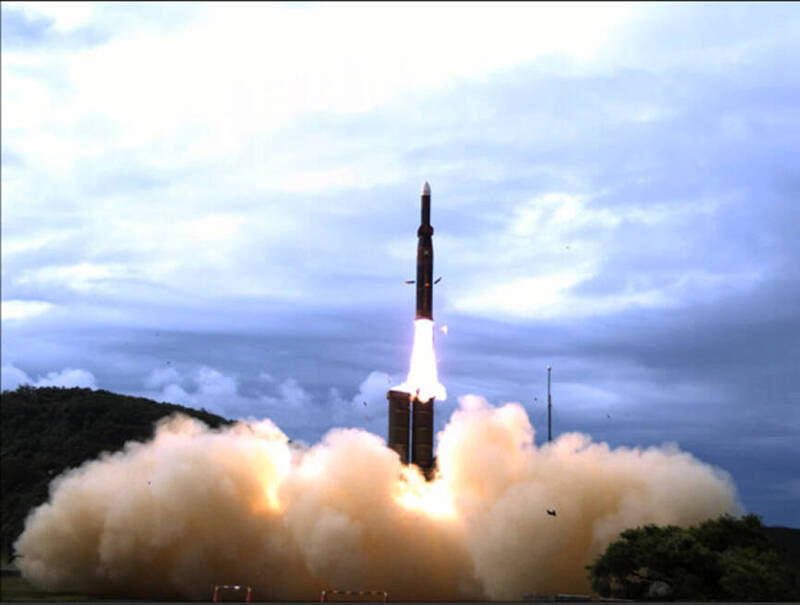
MILITARY BUILDUP: Aside from this year’s budget, the defense ministry detailed its mid-term plan to upgrade, develop and procure defense materiel amid Chinese threatsBy William Hetherington / Staff writer, with CNA請繼續往下閱讀...The military is reviewing budget execution trends and postponing non-urgent projects to maximize defense spending, the Ministry of National Defense said yesterday as it submitted its budget for next year and other defense documents to the legislature.The ministry said China’s “gray zone” harassment of Taiwan has intensified while its military capabilities continue to expand rapidly. The assessment was included in its “Five-Year Force Buildup and Administration Plan Report” (五年兵力整建及施政計畫報告), submitted alongside the defense budget for this year and the “2026 China Military Power Report” (中共軍力報告書).China continues joint combat-readiness patrols, military exercises and China Coast Guard operations, while using maritime militia forces, legal and psychological warfare, and economic coercion. These activities seek to treat the Taiwan Strait as internal waters and strengthen military deterrence against Taiwan, while improving Beijing’s ability to transition from training to combat, the ministry said.The ministry’s domestic priorities include new rifles, night-vision optics, portable counter-drone systems, wheeled combat vehicles and armored fighting vehicles (AFVs).The military is upgrading submarines and testing the domestically built Hai Kun (海鯤), while developing rescue and replenishment vessels, drones and uncrewed boats.It is to procure the Strong Bow (強弓) medium-range anti-tactical ballistic missile system and build a multilayered air-defense network under the “Taiwan Shield” (T-Dome) framework. Other priorities include the Tactical Assault Kit (TAK), upgraded air-combat training systems, digitized command and communications networks, and an islandwide fiber-optic backup network.US procurement priorities include M109A7 self-propelled howitzers and HIMARS multiple-launch rocket systems. The military will continue acquiring Altius 600M and Switchblade 300 systems, and add Altius 600ISR and 700M attack drones.The army has budgeted NT$57.07 billion (US$1.8 billion) from next year to 2033 for 178 domestically developed Cheetah (獵豹) AFVs, armed with 105mm cannons. The D3 prototype has passed evaluation, with procurement to begin next year. The vehicles will have a maximum speed of 100kph, a range of 500km and the ability to fire while moving.The army is also to spend NT$10.7 billion from next year to 2032 on 4,647 light tactical off-road vehicles. Another NT$79.54 billion from next year to 2034 is budgeted to replace aging CM21 armored personnel carriers with 410 wheeled combat and command vehicles.The navy has budgeted NT$18.28 billion from next year to 2032 for a follow-on oil and ammunition replenishment ship. It operates the Panshih (磐石) and Wuyi (武夷), which entered service in 2015 and 1990 respectively, with the Wuyi nearing the end of its service life.It will also spend NT$21.16 billion from next year to 2034 on two follow-on rescue vessels, as existing ships are more than 80 years old. Another NT$13.85 billion is budgeted for a submarine rescue vessel as the Hai Kun and subsequent domestically built submarines enter service.The air force has budgeted NT$36.04 billion this year to 2032 for the Strong Bow medium-range anti-tactical ballistic missile system, previously funded through classified allocations.The system is designed to intercept tactical ballistic missiles at ranges of up to 1,000km and will be integrated with lower-tier systems to form a multilayered defense network. Delivery is scheduled to begin in 2028, although the number of systems remains classified.Developed by the National Chungshan Institute of Science and Technology, the Strong Bow is a mobile interceptor designed to work with Patriot and Sky Bow III (天弓三型), military sources said.The army has budgeted NT$10.73 billion from next year to 2030 for a second phase of night-vision optics procurement, including 41,000 monocular and 10,778 binocular devices.The procurement follows concerns over shortages after some service members conducting nighttime drills in Taipei were seen without night-vision gear. The army said shortages could affect wartime guard duties.The army also plans to spend NT$2 billion from next year to 2031 on 129,759 protective masks and 264,278 filters, saying its T3-75 masks, manufactured in 1986, are no longer adequate against chemical, biological, radiological and nuclear threats.As new equipment enters service, the military will retire equipment that no longer meets operational requirements and adjust force structures and personnel allocations, the ministry said.Garrison and reserve forces will also be reorganized based on operational scenarios and mobilization requirements.Drawing lessons from the wars in Ukraine and the Middle East, the ministry said it would prioritize new weapons, communications and intelligence resilience, ammunition, mobilization and training readiness.It said it has reviewed previous budget execution in line with Executive Yuan guidelines and will postpone non-urgent projects to direct funds toward the military’s most pressing needs.新聞來源:TAIPEI TIMES
评论 (0)