
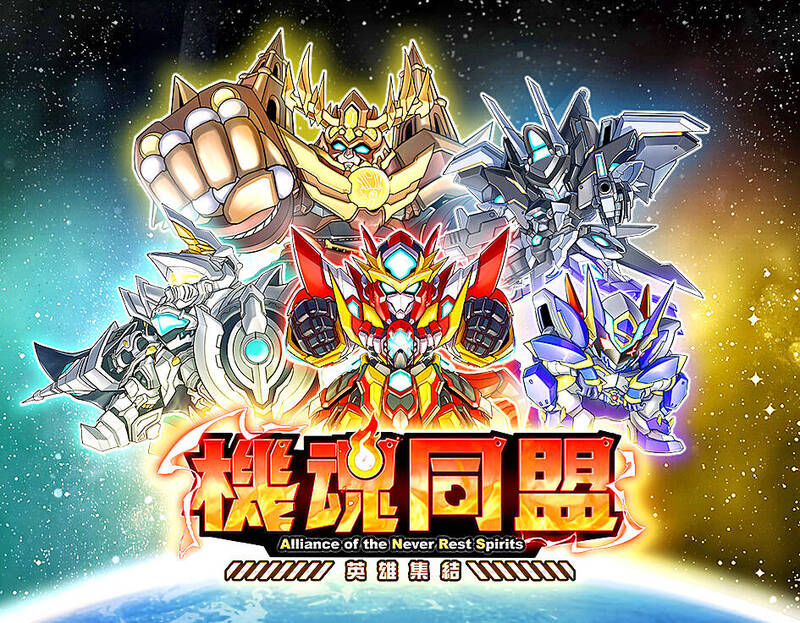
By Wu Po-hsuan and Fion Khan / Staff reporter, with staff writerTaiwanese creators are bringing original mecha toy intellectual property (IP) featuring diverse designs to local and overseas market.請繼續往下閱讀...An original IP refers to a product or creative property developed from scratch by a person or a team, featuring unique characters and offering commercial potential across multiple fields. It can be further adapted into comics, games, films or TV productions, or developed into physical merchandise.Veteran IP producer Luo Chi-ming (羅際明) said that he traced the history of robot toys, and that the trend took off in the 1970s when Japanese toy and snack companies invested in advertising and animation to promote their products.Well-known IPs included Gigantor, Mazinger Z and Transformers, which also helped fuel the chogokin toy craze, he said.In the 1980s and 1990s, titles such as The Super Dimension Fortress Macross and the Gundam series expanded the genre beyond children’s toys, targeting teenagers and adults, Luo said.In the past few years, as players have grown older and digital games have proliferated, mecha model kits have become a nostalgic passion for “kids at heart,” he said.Taiwan was once home to numerous plastic injection-molding factories that served as major contract manufacturers for leading international toy companies, but that industry later moved overseas, he said.However, Taiwan remains an important test market for Japanese companies, with products often piloted here before being launched overseas.The mecha market is enormous, Luo said, adding that sales of the Gundam IP alone reached ¥254.3 billion (about US$1.63 billion) last year.While it is difficult for Taiwanese original IPs to compete with established franchises, they can look to Southeast Asia for further market expansion, he said.Among the Taiwanese creators is Chou Ta-mu (周大木), whose core business is automotive parts and customization, and who has loved mecha models since childhood.Chou said the decision to enter the toy market was largely driven by the COVID-19 pandemic, when orders at his company ground to a halt.Chou said that confident in his team’s creativity and design capabilities, and fueled by his own passion for mecha, he took what he called “a mysterious sense of confidence” and embarked on a journey to create an original Taiwanese mecha IP.Chou founded the Giga Garage brand, blending elements such as anime-style heroines, mecha and space monsters with Taiwanese street food. The concept gave rise to the model toys Ignatius (英格納休斯) and Aurelian (奧雷利安), the first and second machines in the Shen Ji Mecha Wars (神姬機鬥傳) series. With Japanese-style packaging and a mid-range pricing strategy, the Shen Ji series has entered the Japanese market, where its sales outnumber those in Taiwan.Separately, Chiu Chi-kuan (邱繼寬), founder of Model Oasis, has created an original humanoid mecha named Heron (蒼鷺), inspired by the migratory journeys of birds.The design symbolizes the idea that Taiwanese can thrive wherever they go, but would ultimately return home to contribute to their country, he said, adding that it is the project’s first flying, military-style humanoid mecha.While Heron’s realistic design occupies a relatively niche market, toys should possess a distinct identity, he said.The product line adopts a customizable approach, offering a variety of interchangeable weapons and equipment that allow users considerable freedom in configuring their models, he said.Chiu, who has operated Model Oasis in Chiayi for about five years, credited his venture to a deep love for Taiwan and a desire to pour his passion into developing an original Taiwanese mecha intellectual property.He said that despite growing competition from low-cost Chinese products in the market, he remains optimistic.He said while he believes copyright awareness in China still has room for improvement, he intends to continue focusing on original creations rather than following trends, providing discerning collectors with the unique products they seek.Meanwhile, A.N.R.S-Heroes Assemble, a 2D pixel-art mecha action game developed by Taiwanese creative collective ANRS, is scheduled for release on PC next year, the group said.ANRS was founded online 15 years ago by a group of mecha enthusiasts, with half of its members having experience in the gaming industry.In addition to publishing fan magazines and producing podcast shows, the group regularly runs booths at the Fancy Frontier anime convention for over a decade.The team’s marketing executive Liu Li-fan (劉立凡) said the game, targeting men in their 30s and 40s, features 2D side-scrolling action which allows players to execute combo attacks and ultimate moves using simple button inputs.The game also pays homage to Japan’s Super Robot Wars series by incorporating a character progression system, featuring a close-combat fighter specializing in martial arts, he said, adding they plan to include 15 stages in the final game.A demo version was showcased at the G-Eight Game Show in December last year and at the Taipei Game Show earlier this year, where it received positive feedback, he said, adding that they hope the title would recreate the exhilarating combat experience of classic arcade games when it is launched on PC next year.新聞來源:TAIPEI TIMES
评论 (0)