
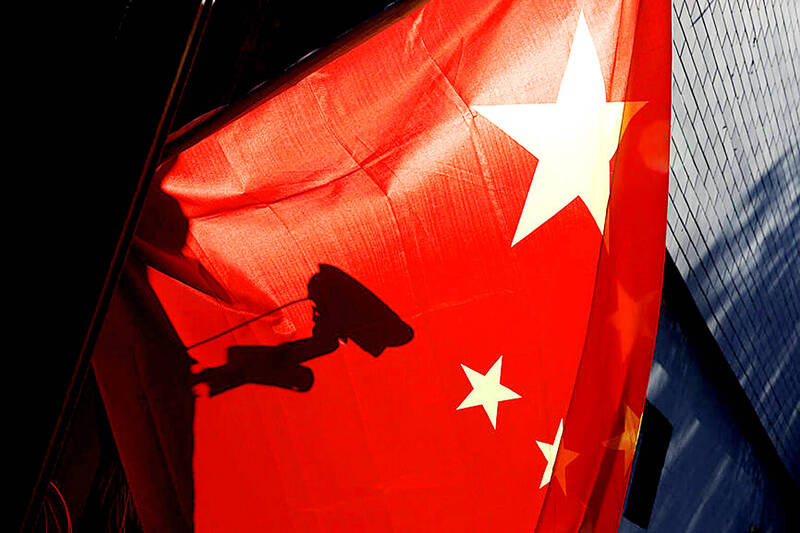
NO LIMITS:More legislation expanding Beijing’s control over the movement of people, money and information raises risks for Taiwanese travelers and businesses, officials saidBy Su Yung-yao and William Hetherington / Staff reporter, with staff writer and CNA請繼續往下閱讀...China is set to implement several laws in the coming months that expand the definition of national security, creating greater risks for Taiwanese traveling to or doing business in China, Taiwanese officials said yesterday.Beijing’s Ethnic Unity and Progress Promotion Law took effect on July 1, while a draft “Internet Information Service Management Measures” finished its public consultation on Aug. 2, but has yet to be adopted. China’s Regulations of the State Council on Exit and Entry Administration are to take effect on Tuesday next week, while amendments to its National Defense Mobilization Law and the Ministry of Public Security’s Measures for the Supervision and Inspection of Cyberspace Security are to take effect on Oct. 1.An official familiar with cross-strait affairs, speaking on condition of anonymity, said the laws reflect Beijing’s continued expansion of the concept of national security beyond traditional security concerns to information, business, and the movement of people, money and information.These laws allow authorities to regulate such activities in the name of national security and national interests, the official said.The measures come as the Chinese Communist Party (CCP) prepares to hold its fifth plenum this year and its 21st National Congress next year, the official said, adding that Beijing needs a relatively stable social environment.Social control and security management are likely to become increasingly stringent, with the laws providing a more systematic framework for such efforts, they said.Terms such as “national security” and “national interests” are broadly defined, they said.The Mainland Affairs Council has described such provisions as providing “blanket authorization,” allowing Chinese authorities considerable discretion in determining what constitutes a security or national-interest concern.This creates uncertainty for Taiwanese traveling to China while providing a legal basis for cross-border repression, the official said.The measures are not limited to Chinese citizens: Anyone deemed to have harmed China’s national interests or national security could face investigation or punishment under Chinese law, they said.The laws also decentralize enforcement powers.Under the new exit and entry regulations, for example, authorities in border counties and cities would have enforcement powers, the official said.The forthcoming cyberspace security inspection measures would allow county-level public security authorities to investigate individuals and inspect items such as mobile phones and laptops, the official said.“Law is merely the packaging,” the official said, adding that arrests and searches have already occurred in various forms.The new laws would directly authorize local government agencies to carry out such actions while warning that certain behavior or speech could result in arrest or harassment, which could encourage self-censorship and create a chilling effect, they said.The laws also explicitly refer to Chinese President Xi Jinping (習近平) and socialism, reflecting a more closed ideological environment, the official said, adding that they could help lay the legal and ideological groundwork for Xi to secure a fourth term as party leader at the 21st National Congress.As the CCP has consistently framed cross-strait relations around the “one China” principle, the laws are likely to negatively affect the movement of people, money and information across the Taiwan Strait, the official said.Taiwan should issue appropriate risk warnings, they said.One of the most consequential measures is the amended National Defense Mobilization Law, which represents the first comprehensive overhaul of the legislation since it was enacted 16 years ago, another Taiwanese national security official said.The revised law would allow the Chinese state to seize private property whenever deemed necessary, they said.It should not be viewed solely as a strategic tool aimed at Taiwan, the official said, but also as a mechanism for comprehensively integrating domestic resources and a reflection of Beijing’s growing security concerns amid intensifying competition with the US.The current version of the law focuses on the division of responsibilities between military and civilian authorities, particularly how the government could mobilize civilian resources and personnel to support the military during wartime or emergencies, they said.The latest revision has five notable features, they said.First, it expands the purpose of the legislation to include protecting China’s “development” interests.Second, it explicitly establishes the leadership of the CCP and Xi’s military-strengthening doctrine as fundamental political principles governing national defense mobilization.Third, for the first time, it defines national defense mobilization as activities designed to “ensure a rapid transition between peacetime and wartime,” and convert economic and social strength into national defense capabilities.Fourth, it changes the legal treatment of civilian resources from “requisition” to “expropriation.” The distinction is significant because expropriation provides less protection for ownership, meaning the state could forcibly acquire private property where deemed necessary.Fifth, the law expands mobilization to include data and modern technologies, including supply chains and artificial intelligence. It also calls for supply-chain security assessments to address the risk of disruptions.The amendments seek to comprehensively integrate domestic resources by bringing technology, industry and infrastructure under greater state control, the official said.They also reflect the CCP’s concerns about the security of its rule, the official said.Using legislation to bolster state control shows that the authorities increasingly view almost everything as a security issue.For Taiwanese businesses, the amendments could increase both political and economic risks, they said. Taiwanese companies could have their assets expropriated or have their operations classified as resources related to China’s “development” interests, raising the risk that investments could be “gone for good,” the official said.新聞來源:TAIPEI TIMES
评论 (0)