
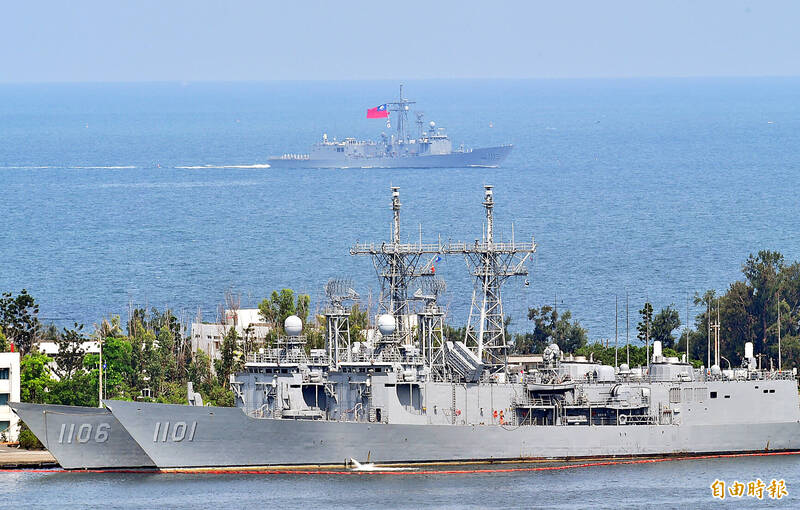
SIZE MATTERS:Large ships are politically attractive as visible symbols of national defense, but small surface combatants are more likely to survive an initial strikeBy Chen Yu-fu and Sam Garcia / Staff reporter, with staff writer請繼續往下閱讀...Taiwan needs to restructure its naval fleet from focusing on large warships, which are “sitting ducks” for China’s advanced tracking technology, to smaller, stealthy corvettes that are harder to detect but retain sufficient firepower to deter a Chinese invasion, a Taiwanese academic and a former US military commander said in an article published on Friday in the journal Foreign Affairs.Taiwan does not need a fleet capable of competing with the Chinese navy for traditional control of the Taiwan Strait, but rather “sea denial” capabilities that would prevent China from freely using the waterway, Taiwanese aerospace and security expert Holmes Liao (廖宏祥) and former US Navy admiral Dennis Blair wrote the article, titled “How Taiwan can win the Strait: A nimbler navy can deny China.”The focus of “sea denial” is “preventing China from using the waterway freely enough to carry out an invasion” by deterring its forces with smaller vessels, as well as shore-based mobile launchers, aircraft armed with anti-ship missiles and submarines, they said.“Taiwan has traditionally favored large ships such as destroyers and frigates to form the core of its fleet,” they said, adding that Taiwan’s current naval plans include replacing an aging surface fleet with large, expensive new ships.However, China has invested in cutting-edge surveillance, intelligence and reconnaissance, as well as electronic warfare systems, drones and missiles, making Taiwan’s large surface ships “a liability,” they said.“These same technologies make China’s large amphibious ships more vulnerable in restricted waters, and those ships cannot be replaced by smaller, stealthier alternatives” as they would be necessary for an assault on Taiwan, the article said.Taipei could take advantage of that asymmetry by replacing large destroyers and frigates with numerous small surface combatants that are more likely to survive an initial Chinese strike and remain capable of deterring an invasion fleet, the authors said.The smaller ships could “operate independently while sharing information and coordinating their attacks,” they said.Liao and Blair, who was commander in chief of the US Pacific Command from 1999 to 2002, said that Ukraine’s Black Sea campaign — which “combined land-based anti-ship cruise missiles, swarms of uncrewed surface vessels, aerial drones and external intelligence” — showed that a weaker power could constrain a stronger opponent in contested waters.Taiwan’s continued commissioning of “lightweight but heavily armed” missile patrol ships are helping the nation restructure its fleet, they wrote.Sustained production of the ships would lower costs and new weapons, sensors and uncrewed systems could be incorporated into successive batches of the vessels, which cost less than US$200 million, compared with an estimated US$2 billion for a single 7,000 tonne warship, they said.“The obstacles to the transformation of Taiwan’s navy are more institutional than technical,” as large ships are attractive to politicians because they are a highly visible symbols of national defense that bring shipyard contracts and “a sense of national achievement.”“Rather than continue to upgrade these obsolescent, if not obsolete, ships, Taiwan should progressively decommission them and redirect scarce resources toward the lighter surface ships it needs,” Liao and Blair wrote.“The country needs a dispersed, agile and lethal force structure to defeat China in the Taiwan Strait,” they said. “Such a navy will not look as impressive during a fleet review, but it will be a more effective deterrent against a potential Chinese invasion.”新聞來源:TAIPEI TIMES
评论 (0)