
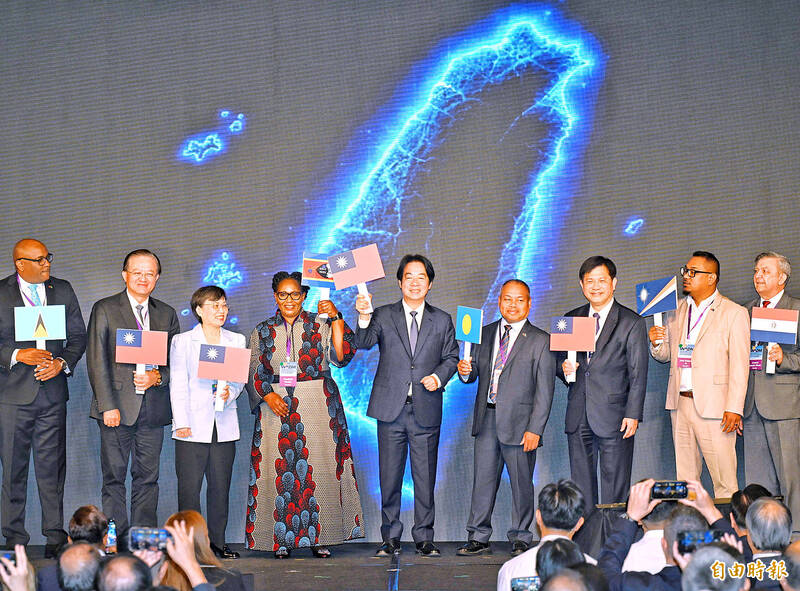
MILESTONE: It is a major breakthrough in Taiwan’s efforts to take part in international organizations, and the nation is confident in what it brings to the table, William Lai saidBy Lee I-chia / Staff reporter請繼續往下閱讀...President William Lai (賴清德) yesterday announced the establishment of the World Alliance for Disaster Management (WADM), calling it a major breakthrough in Taiwan’s participation in international organizations over the past half-century.Lai made the announcement at the opening of the Resilient Taiwan for Sustainable Democracy International Forum, hosted by the Presidential Office in Taipei yesterday. It also marked the second anniversary of the establishment of the Whole-of-Society Defense Resilience Committee.The WADM, an international organization spearheaded by Taiwan, is set to link governments, and disaster prevention agencies and organizations around the world to advance joint training and exercises, as well as mutual assistance and information sharing, with the aim of making Taiwan a cross-border hub for disaster prevention and response coordination, Lai said.The organization’s founding members consist of 11 of Taiwan’s official diplomatic allies with UN seats and the Republic of Somaliland, he said.The WADM is made up of central and local governments, disaster prevention agencies and organizations from 21 countries, including the US, Japan, the UK, Germany, the Netherlands, Poland, Turkey and the Philippines, he said.“Together they form a cooperation network that spans the globe,” Lai said. “The establishment of the WADM is a major breakthrough for Taiwan in over half a century of efforts to take part in international organizations.”The committee was established two years ago with the goal of boosting Taiwanese society’s resilience through public-private cooperation, and to help the government continue to operate effectively, and society and essential services to function as normal should the nation face any type of disaster, Lai said.Taiwan is confident that it has something to offer the international community, he said, citing as an example last month’s Han Kuang military exercises and the Urban Resilience Exercises, which enabled non-military government agencies at the central and local levels to conduct simultaneous drills under the same conditions.As president, his role is to “ensure Taiwan is better prepared and has greater strength to maintain the status quo, and to prevent peace from being undermined by unilateral provocations,” in the face of dramatically changing international landscape and intensifying threats from China, Lai said.Taiwan’s defense budget has doubled over the past decade, Lai said, adding that his administration has for the first time proposed a defense budget that exceeded NT$1 trillion (US$31.44 billion) for next year.The NT$1.1225 trillion budget would put defense spending above 3 percent of GDP, and it is expected to reach 5 percent by 2030, he said.“We are determined to strengthen Taiwan’s self-defense capabilities and to safeguard peace through strength,” Lai said.“Taiwan will continue to expand its participation by contributing to the world, to build trust through professionalism and to connect to the world through cooperation,” he said.He also urged democratic societies to cooperate with each other and spread confidence through resilience when authoritarian forces seek to spread fear and create discord and strife.“Peace through strength, strength through resilience and resilience through unity,” Lai said, adding that all the preparation aims to protect the welfare of Taiwanese, preserve Taiwan’s free and democratic way of life, and defend peace and stability in the Indo-Pacific region and across the world.With an increasingly extreme and unpredictable climate, resilience preparedness also enables society to absorb shocks, recover quickly and ultimately achieve sustainability, he added.The forum brought more than 500 local and international defense experts, officials and business representatives to Taipei yesterday. They exchanged views on climate change, “gray zone” aggression and geopolitical risks, and discussed comprehensive resilience models around the world, military-civilian cooperation, psychological defense and resilience partnerships.新聞來源:TAIPEI TIMES
评论 (0)