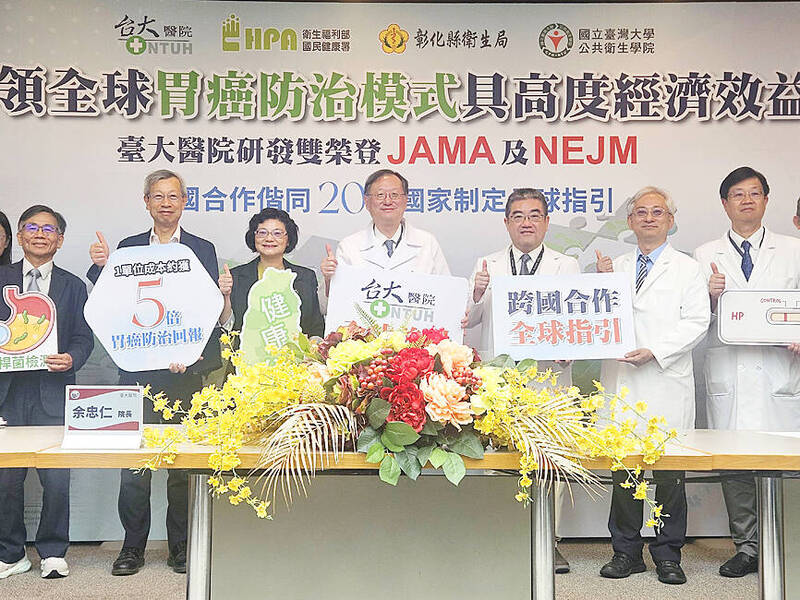
CANCER PREVENTION: The ‘Journal of the American Medical Association’ and the ‘New England Journal of Medicine’ covered NTUH’s two-in-one bacteria screeningBy Jake Chung / Staff writer, with CNA請繼續往下閱讀...A two-decade research effort by National Taiwan University Hospital (NTUH) to develop a two-in-one screening program for Helicobacter pylori, bacteria that increase the risk of colorectal and stomach cancer, has been featured in leading international medical journals and could potentially be adopted by some eastern European and South American countries.The study was published in the Journal of the American Medical Association last month, while guidelines developed in collaboration with experts from 20 countries were published in the New England Journal of Medicine.NTUH Division of Gastroenterology and Hepatology attending physician Lee Yi-chia (李宜家) yesterday said the hospital has long promoted the policy of screening for H pylori to prevent colorectal cancer, a policy it has helped implement in communities from Lienchiang County (Matsu) to rural townships in Taiwan proper.H pylori also increases the risk of people being diagnosed with stomach cancer sixfold, but can be treated, Lee said.While the number of people diagnosed with stomach cancer is lower than those diagnosed with colorectal cancer, the former is deadlier, she said.While both types of cancer have mature methodologies for diagnoses, the method developed by the hospital allowed doctors to screen for colorectal and stomach cancers via bloody stool, she said.The hospital’s screening method was financially sound and practical, she said, adding that a global guideline was developed in collaboration with 35 doctors from 20 countries and the International Agency for Research on Cancer (IARC).The method has also been introduced in Bhutan, and might soon be introduced in eastern Europe, she said.Some South American countries have expressed interest in introducing the method, but efforts were slow due to political instability in the region, she said, adding that other countries, including the US, are slowly introducing the method.The US, Japan, South Korea, and China have a higher prevalence rate of H pylori, so they could consider adopting the method, she said.Health Promotion Agency Deputy Director-general Lin Li-ju (林莉如) said the gastric cancer screening program was initially piloted in indigenous communities, with Lee’s team conducting H pylori testing.The program was gradually expanded to the general population in 2024 and became the sixth cancer type covered by the government-funded cancer screening program this year, she said.As of last month, 600,000 people had undergone screening, with a positivity rate of 22.4 percent, she added.新聞來源:TAIPEI TIMES
评论 (0)