
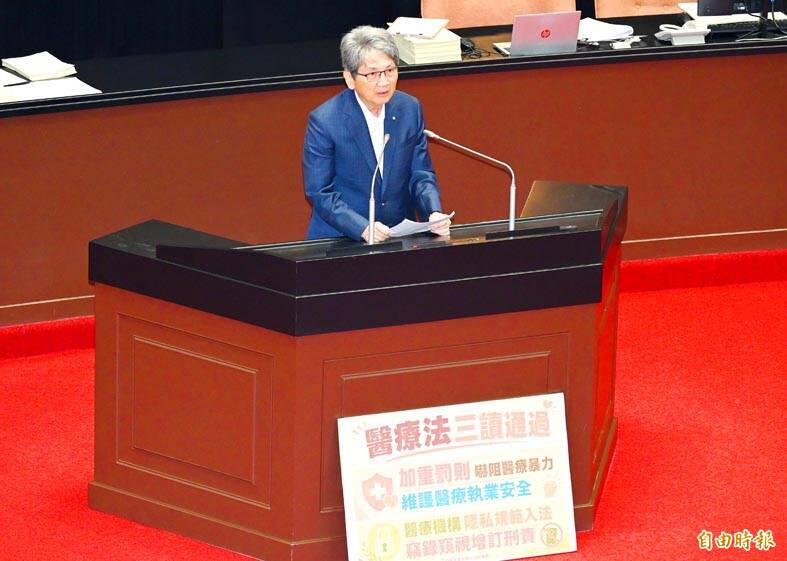
By Chen Chih-cheng / Staff reporter, with CNAThe Legislative Yuan yesterday passed a series of amendments to the Medical Care Act (醫療法) that introduce a prison sentence of up to three years for medical personnel who photograph or film patients’ intimate areas without their consent, in response to a string of incidents involving beauty clinics secretly filming patients.請繼續往下閱讀...The amendments mandate that medical institutions and their staff must not use any tools or equipment to view clients’ intimate areas, or view or listen to their medical records, “without a valid reason.”Those who arbitrarily record, photograph, film or make electromagnetic recordings of patients’ medical records or intimate areas would face up to three years in prison and could be fined up to NT$300,000, with the equipment used subject to confiscation.Those who intend to profit by supplying space or equipment for such recordings and those who intend to distribute the illicit content could be sentenced to between six months and five years in prison, with fines of up to NT$500,000.The amendments were proposed after a series of franchised and independent beauty clinics across Taiwan filmed clients’ intimate parts without consent, resulting in fines or suspensions for at least 21 clinics.Other revisions to the act were adopted yesterday to strengthen protections for medical personnel.The fine for those who subject medical personnel to violence, coercion or threats was raised from between NT$30,000 and NT$50,000 to between NT$50,000 and NT$250,000.Protections were expanded beyond doctors and nurses to include emergency response personnel and related staff.“Public insults” directed at medical staff as a form of violence were added to the act, with a prison sentence of up to two years and fines of up to NT$200,000.Medical institutions that fail to implement safety measures mandated by the central government to protect their staff may be fined NT$30,000 to NT$150,000.The amendment mandates that whenever a medical corporation distributes surplus profits, it must allocate 10 percent toward improving employee welfare, enhancing patient rights and upgrading the quality of its medical environment.Finally, the amendments update the nation’s medical advertising regulations to align with a 2023 Constitutional Court judgement, which found that banning individual physicians from advertising violated their constitutional right to free speech.While the law used to say that only medical institutions could run medical advertisements, the revised act says that physicians are permitted to advertise, although they are limited to the specific medical institution where they are officially registered to practice.新聞來源:TAIPEI TIMES
评论 (0)