
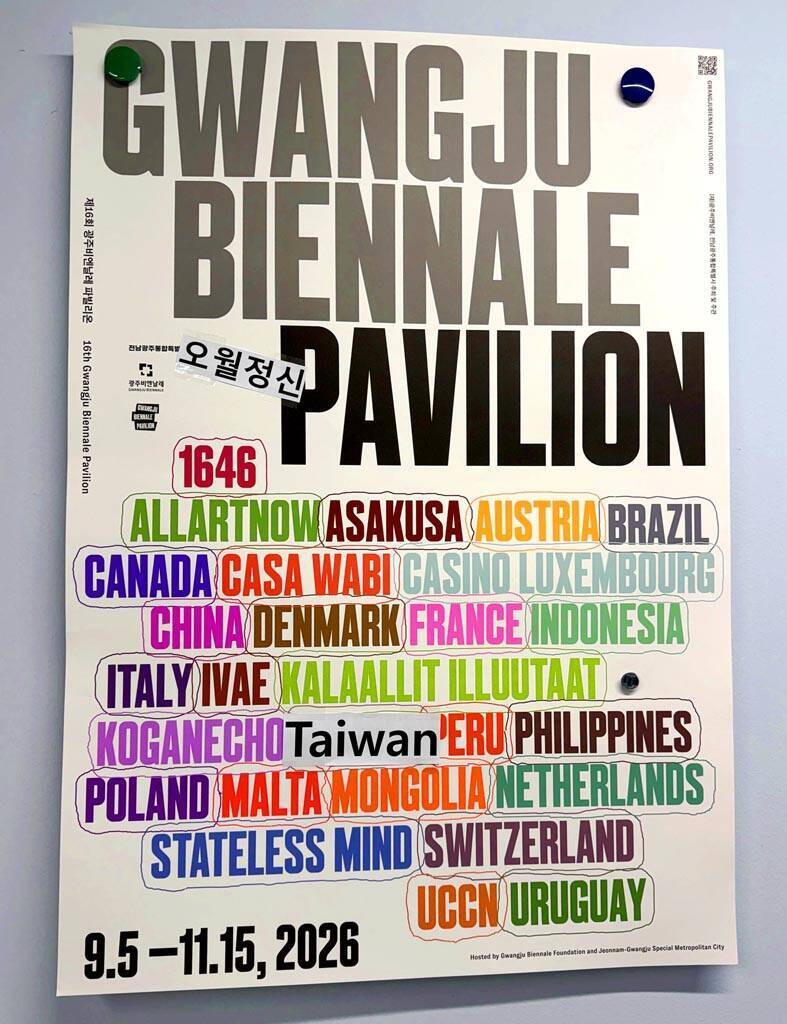
NAME MATTERS: Taiwan had sternly protested the foundation changing the name of its exhibition to ‘NTMoFA’ from ‘Taiwan Pavilion’ without discussion or notice/ Staff writer, with CNA請繼續往下閱讀...The Gwangju Biennale Foundation has agreed to allow Taiwan’s exhibitors to use the name “Taiwan” in the exhibition venue and in official documents and promotional materials, South Korea’s Munhwa Broadcasting Corp reported yesterday.The foundation made the decision after considering Taiwan’s stance that it would withdraw from the exhibition,opening on Sept. 5th, if the name could not be used, the broadcaster said.Earlier yesterday, the Ministry of Culture urged the foundation to respond by today to its request to restore the name of Taiwan’s participating exhibition from “NTMoFA,” the acronym for the National Taiwan Museum of Fine Arts, to “Taiwan Pavilion.”In a statement, the ministry “sternly protested” the foundation’s and the Asia Culture Center’s (ACC) refusal to restore the name and what it described as efforts to prevent Taiwan Pavilion personnel from entering the venue to set up the exhibition, originally scheduled to begin on Tuesday last week.The statement did not specify what action would be taken if the organizers failed to respond.The ministry said it issued statements on Monday and Wednesday last week explaining that the name “Taiwan Pavilion” was changed to “NTMoFA” without discussion or prior notice.It also pointed to a statement issued yesterday by the Taiwan Pavilion’s curator and artists, titled “You Must Change Your Name,” which accused the foundation of repeatedly ignoring the museum’s objections to the name change and said an artistic institution should not become a tool for suppressing self-identification.Over the past week, the ACC has refused to allow Taiwanese exhibitors to enter the venue to set up the exhibition, citing the lack of an official document from the foundation, the ministry said.Although the museum received a copy of a foundation letter permitting them to enter the venue on Wednesday, the ACC continued to say it had not received the document and refused to allow NTMoFA representatives to enter, the ministry said.After a museum representative took photographs to document the incident, ACC venue staff demanded to inspect the person’s phone and asked them to delete the photographs, it said.Furthermore, the foundation proposed relocating Taiwan’s exhibition to an alternative storage space that was much smaller than the original site, the ministry said.Members of the international artist community and art workers have also spoken out, urging the foundation not to use its authority to determine the name under which participants are identified and to restore the name “Taiwan Pavilion” as soon as possible, it said.Earlier, the foundation said it would neither intervene in nor censor the content or expression of exhibitions, and would continue negotiations to ensure that the NTMoFA’s exhibition proceeds as planned.The foundation said the exhibition is purely an artistic partnership and that it has never intervened, nor would intervene, in the NTMoFA pavilion’s curation, selection of works, installation methods or the expressions of its curator and artists.It said it was concerned that the controversy had developed into a political and diplomatic issue, adding that the dispute stemmed from differing interpretations of administrative procedures and the agreement concerning the pavilion’s participating institution and how it should be labeled in official materials.The foundation said that the agreement signed on Jan. 12 clearly identified the Gwangju Biennale Foundation and the National Taiwan Museum of Fine Arts as the parties involved and that its implementation was based on that agreement.In contrast, the ministry has insisted that the original agreement was that the name “Taiwan Pavilion” would be used and was only changed by the foundation in June.The foundation argued that the labeling used in official documents and promotional materials should be distinguished from the exhibitor’s own self-identification.Regarding the difficulties encountered by Taiwan’s exhibitors, the foundation said it had signed a contract with the venue for use of the exhibition space, but the contract did not specify the countries or institutions that would hold exhibitions there.It said it would ask the ACC to open the space and cooperate with the installation and exhibition operations so that the NTMoFA’s exhibition can proceed as planned.If further delays or difficulties arise, the NTMoFA could consider using an alternative space inside the biennale venue, it added.The foundation concluded that both the autonomy of exhibitors and the official operations stipulated in the agreement should be respected, saying the priority was not for the two sides to “more loudly propagate their own stance,” but to quickly find a workable solution that would allow the exhibition to be held as scheduled.Founded in 1995, the Gwangju Biennale in South Korea is Asia’s oldest and most prestigious biennial of contemporary art.In an August titled “Who is Afraid of the Name ‘Taiwan Pavilion,” the coalition of South Korean artists has criticized the biennale for disregarding artists’ right to identify their own nationality and failing to engage in discussion and consultation, and said it is deeply troubling that such “political censorship” occurred in Gwangju, a city known as South Korea’s “sacred ground of democracy.”“The Taiwan Pavilion case reflects a broader problem in the international art world, where discrimination based on nationality, race, gender, religion or political views has led to artworks being altered or removed, exhibitions and public statements being canceled, and artists and cultural workers being silenced,” the group said.新聞來源:TAIPEI TIMES
评论 (0)