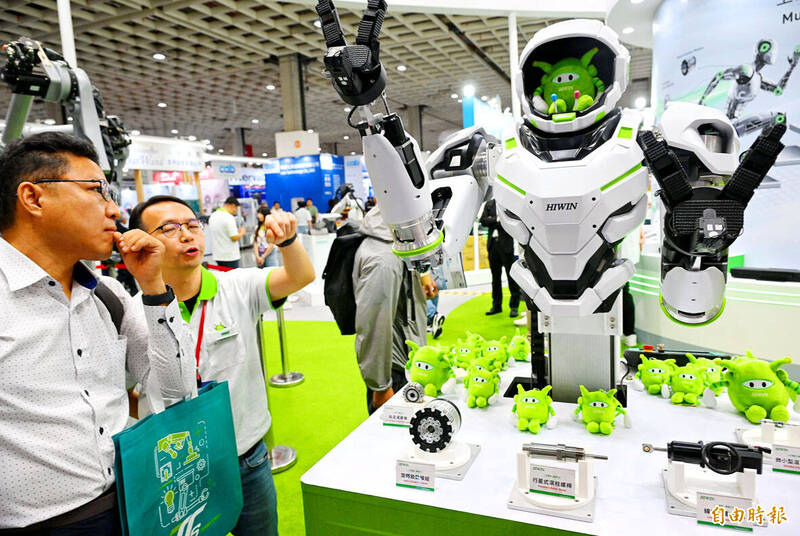
BLEEDING EDGE:The latest and greatest in robotics, AI, sensors, power sources, servos, joints, visual recognition and more are showcased in NangangStaff writer, with CNA請繼續往下閱讀...Intelligent Asia, Taiwan’s largest industrial exhibition and a major platform for artificial intelligence (AI), robotics and automation, opened yesterday at the Taipei Nangang Exhibition Center.The exhibition features about 1,200 vendors from 16 countries and regions across 4,500 booths across halls 1 and 2, showcasing advanced technologies including AI-powered robots, automation equipment and smart logistics, event organizers said.The expo, which runs through Saturday, showcases key technologies required for humanoid robots, including AI computing, visual recognition, sensing systems, motion control, power supplies, servo motors and joint actuators, organizers said.This year’s event — which encompasses the Taiwan Automation Intelligence and Robot Show and the Taipei International Industrial Automation Exhibition — highlights the nation’s robotics supply chain, including Solomon Technology Corp (所羅門), Techman Robot Inc (達明機器人), Advantech Co (研華), Nexcom International Co (新漢), Swancor Robotech Co (上緯智聯), Aurotek Corp (和椿科技) and Chieftek Precision Co (直得科技).At the show, Coretronic Intelligent Logistics Solutions Corp (中光電智能物流) is showcasing its autonomous mobile robot carrier and forklift.Coretronic Intelligent senior project manager Ritz Chang (張明儒) said the carrier could be used in a wide range of settings, such as unloading cargo at ports, delivering patients’ medical records in hospitals or delivering food.Several food delivery services in the US are deploying thousands of AI-driven delivery couriers, Chang said.“They are replacing food couriers in the United States because low birthrates are a global trend, and wages are high in the States,” Chang said.“[AI-driven delivery couriers] also don’t feel tired, and they offer more scheduling flexibility,” he said.Hiwin Technologies Corp (上銀科技) is displaying a humanoid robot designed to supply components in supply chains, as well as an eight-axis robotic arm capable of making sophisticated movements in confined spaces such as containers.Hiwin deputy general manager Kyle Wong (翁振民) said the company developed the robots in anticipation of greater automation in the logistics sector.“Since the job mainly involves loading and unloading goods and is very repetitive and monotonous, fewer and fewer people will want to do this kind of work in the future,” Wong said. “So, we are developing these robots primarily to take over this kind of boring and repetitive work.”Swancor Robotech, a subsidiary of Swancor Holding Co (上緯投控), is demonstrating the capacity of the company’s quadrupedal robot at the event.The company said it plans to launch a robot dog fully designed and developed in Taiwan, dubbed the "Taiwanese native dog," by the middle of next year.Local assembly is expected to begin by the end of this year, as the company aims to develop core technologies including the robot’s "brain," control systems and joint modules, moving beyond its current role as an importer and distributor, it said.Swancor said its robot dogs can perform autonomous navigation, image recognition, voice commands and environmental sensing for applications including power facility and factory inspections. They can also climb stairs and overcome obstacles.Swancor Holding chairman Robert Tsai (蔡朝陽) said the company estimates Taiwan’s annual robot dog market at more than 3,000 units, worth NT$2 billion to NT$3 billion (US$62 million to US$93 million).The government is also developing a domestic quadrupedal robot platform. The Industrial Technology Research Institute has worked with Compal Electronics Inc (仁寶), Inventec Corp (英業達) and Solomon Technology Corp (所羅門) to develop robots for firefighting, security and infrastructure inspections.Those developments were made possible thanks to a platform that allows domestic companies to test and replace key components, including motors, visual sensors and joints, to build a local robotics supply chain and combine Taiwan’s hardware strengths with AI and software, according to the Ministry of Economic Affairs.新聞來源:TAIPEI TIMES
评论 (0)