
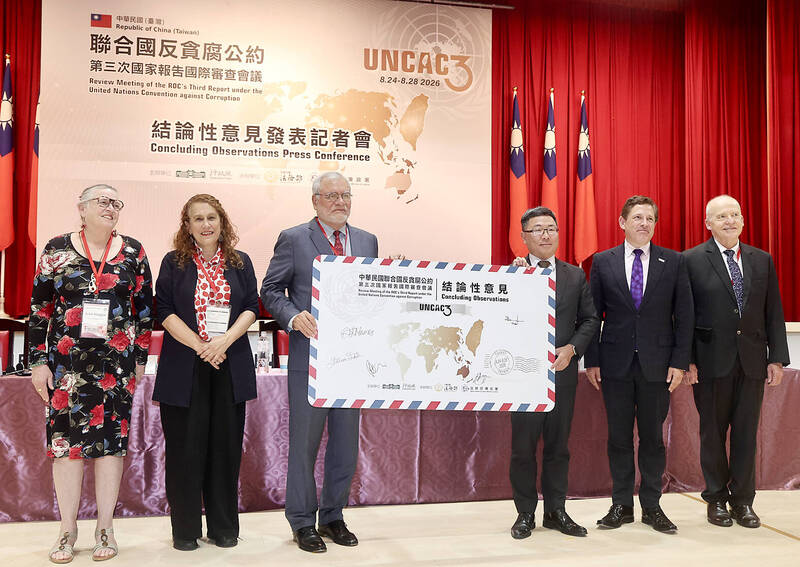
By Jake Chung / Staff writer, with CNAFive international experts on the review committee for Taiwan’s third report under the UN Convention against Corruption (UNCAC) said yesterday that Taiwan has established a mature and innovative anti-corruption governance system.請繼續往下閱讀...The five-member committee spent two days reviewing Taiwan’s implementation of the UNCAC.The committee affirmed 41 measures adopted by Taiwan to implement the convention and offered 78 recommendations for improvement in areas including government procurement, combating corruption in the private sector, managing conflicts of interest, political donations, transparency in political lobbying, anti-money laundering policies and the recovery of illicit assets.Committee chair Jose Ungaz said the review demonstrated that Taiwan has found its footing and established a mature and innovative anti-corruption governance system.The next step is to establish governance systems that are quantifiable and verifiable, and that can demonstrably reduce the risk of corruption, the committee said.Committee member Gillian Dell said systems Taiwan has adopted, including the Government Procurement Integrity Platform and the Government e-Procurement System, could serve as models for other countries.However, Dell said Taiwan could improve transparency in national defense, maintain judicial capacity and establish stronger and more stable anti-corruption mechanisms in government procurement processes.Committee member Duncan Hames said Taiwan’s Enterprise Service Integrity Platform and its practice of considering anti-corruption efforts at state-owned enterprises when determining their eligibility for the Integrity Award demonstrate Taiwan’s commitment to building a culture of integrity in the private sector.Hames suggested that Taiwan increase the transparency of information on registered companies and improve the reliability of information in government company registry archives. He also said the government should establish a system of criminal liability for legal entities.Committee member Peter Ritchie said Taiwan has strengths in its prosecutorial system, anti-money laundering and corruption risk assessments, virtual asset management and mechanisms for recovering illicit assets, and should capitalize on those advantages.Ritchie also suggested that the government share actual case studies and its experiences in handling them with the private sector and other countries.Committee member Julie Haggie said she was impressed by the high level of government participation in the review and praised Taiwan’s implementation of conflict-of-interest regulations.However, Haggie said the government could improve the immediate transparency of political donations, political lobbying and lobbying registration.Minister without Portfolio Lin Ming-hsin (林明昕) said the government’s work would begin following the conclusion of the review. The committee’s recommendations, he said, would serve as references for future anti-corruption policies and legislative drafting.Taiwan looks forward to presenting the results in its next national report and at the next session of the international review committee, he added.Five international experts on the panel of the Review Meeting of the ROC’s Third Report under the United Nations Convention Against Corruption (UNCAC) said yesterday that Taiwan has established a mature and innovative anti-corruption governance system.The five international committee members spent two days reviewing Taiwan’s implementation of the UNCAC.Yesterday, the members affirmed Taiwan’s 41 measures on implementing the UNCAC and offered 78 suggestions on how to improve government procurement, combat corruption in the private sector, resolve conflicts of interest, handle political donations, increase transparency in political lobbying, strengthen anti-money laundering policies and recover illicit assets.Chair of the International Review Committee Jose Ungaz said the review demonstrated that Taiwan has found its footing and established a mature and innovative anti-corruption governance system.The next step is to establish governance systems that are quantifiable, verifiable and can demonstrably reduce the risk of corruption, the committee said.Committee member Gillian Dell said that systems Taiwan has adopted, such as the Government Procurement Integrity Platform and the Government e-Procurement System, should serve as role models for other nations.Dell said, however, that greater transparency in national defense, efforts to maintain judicial capacity and stronger and more stable anti-corruption mechanisms in government procurement processes could be improved.Committee member Duncan Hames said Taiwan’s Enterprise Service Integrity Platform and its practice of considering anti-corruption efforts at state-owned enterprises when determining whether they are eligible for the Integrity Award show that Taiwan is committed to building a culture of integrity in the private sector.Hames suggested that Taiwan could increase the transparency of information on registered companies and improve the reliability of information in government company registry archives, adding that the government should also establish a system of criminal liability for juridical persons.Committee member Peter Ritchie said Taiwan has advantages in its prosecutorial system, anti-money laundering and anti-corruption risk assessments, virtual asset management and measures to recover illicit assets, adding that Taiwan should capitalize on those advantages.Ritchie also suggested that the government share actual case studies and Taiwan’s experiences in handling them with the private sector and other nations.Committee member Julie Haggie said it was impressive how involved Taiwan’s government was during the review, adding that Taiwan’s implementation of conflict-of-interest regulations was also admirable.The government could improve the immediate transparency of political donations, political lobbying and lobbying registration, Haggie said.Executive Yuan Minister without Portfolio Lin Ming-hsin (林明昕) said the government’s work would begin after the conclusion of the review, adding that the suggestions made by committee members would serve as references for the government’s future anti-corruption policies and legislative drafting.Lin said Taiwan looks forward to presenting the results in its next national report and at the next session of the international review committee.新聞來源:TAIPEI TIMES
评论 (0)