
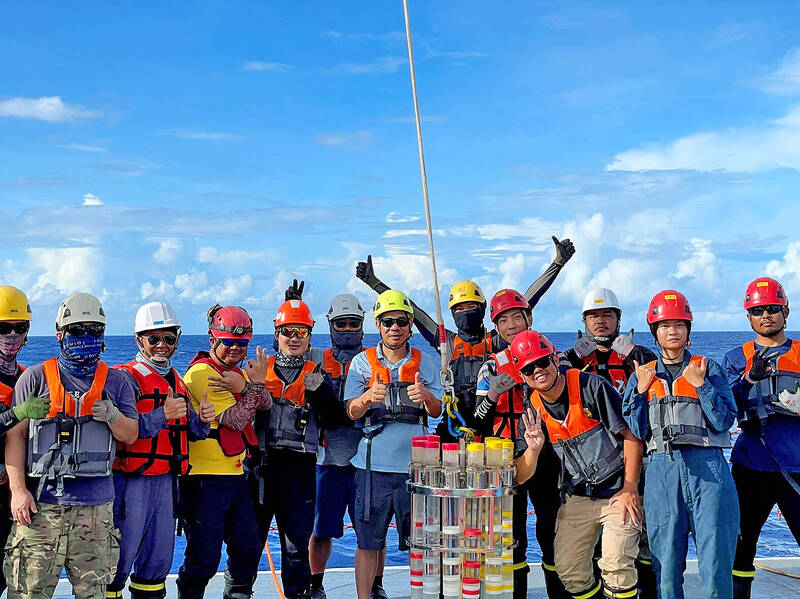
By Esme Yeh / Staff reporter“Blue carbon” produced by coastal ecosystems might “ride” ocean currents for more than 1,000km to fuel deep-ocean carbon sinks, National Sun Yat-sen University researchers said on Thursday.請繼續往下閱讀...The university’s Carbon Research Lab, led by Hung Chin-chang (洪慶章), a professor of oceanography, conducted oceanographic observations in the low-latitude warm pool of the northwestern Pacific, an area often called an “ocean desert” due to low biological productivity and a lack of nutrients.Researchers detected biosignals of algae, mangroves and seaweed at depths of 500m to 1,000m in the area, Hung said.The results showed that organic matter produced in coastal systems can be carried by ocean circulation systems into the deep sea far from land, the university said in a statement.The research is primarily funded by the “sailing to the blue sea” project of the the National Science and Technology Council, it said.The research team on the research vessel Legend in 2023 visited five oceanographic stations in the northwestern Pacific, where they conducted observations, it said.Drifting sediment traps were deployed in waters at depths of 150m, 500m and 1,000m around the stations to collect sinking organic particles, the statement said.Stable carbon isotopes from the samples were used to distinguish between land-derived and ocean-derived sources, while environmental DNA (eDNA) was used to identify the organisms from which the carbon originated, it said.The results showed that eDNA signals of large algae, mangroves and seaweed were detected at depths of 500m and 1,000m, it said.The five oceanographic stations spanned four degrees of latitude, with some of them about 900km from the Philippines and more than 1,200km from Indonesia, the university said.However, eDNA and isotope evidence is insufficient to determine whether the blue carbon originated from Palau, the Philippines or Indonesia, it said.Mangroves, seaweed beds and algae are important coastal blue carbon ecosystems that can absorb carbon dioxide and store it in their biomass and surrounding environment, the university said.While previous studies mostly focused on marine biological carbon’s downward flux from the ocean surface, the university’s research showed that carbon can travel via currents to the open ocean — a carbon transport pathway that has not received much research attention, it said.The research is significant, as it provides evidence showing that carbon sequestrated by coastal systems can reach the deep ocean, it said.Surface currents, submarine currents and mesoscale eddies all contribute to the transportation processes, it added.The research showed that carbon in the ocean can float a long way out to sea before sinking, the university said.The particulate organic carbon flux measured at 1,000m were 2.7 to 4.2 times higher than the values predicted with the Martin Curve carbon attenuation model, it said.That shows that the conventional vertical sinking model might not fully explain the carbon flux mechanism in the deep ocean, the university added.新聞來源:TAIPEI TIMES
评论 (0)