
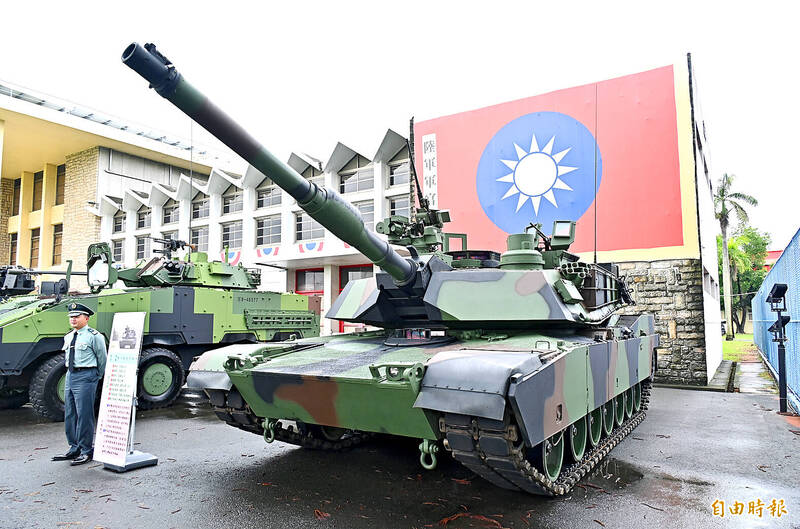
PROJECT PLAN:The defense ministry plans to expand production lines, including for warhead bodies and explosives, and introduce semi and fully automated equipmentBy Aaron Tu and William Hetherington / Staff reporter, with staff writer請繼續往下閱讀...The military is significantly expanding domestic production capacity to improve self-sufficiency in equipment and ammunition during wartime, the Ministry of National Defense’s proposed budget for next year showed.The Armaments Bureau’s Production and Manufacturing Center plans to invest more than NT$14.15 billion (US$447.4 million) from this year to 2032 to establish or expand production capacity at four of its factories, it showed.The project covers production capacity for armored vehicles, artillery, ammunition, explosives, optical equipment, specialized batteries, and chemical, biological, radiological and nuclear defense gear.Demand for various types of ammunition is expected to increase as new tanks are fielded, troop numbers grow and reserve combat capabilities are reinforced, the bureau said.It plans to expand production lines for warhead bodies, cartridge cases, primers, propellants, explosives, gun barrels, optical equipment and gas masks, while introducing semiautomated and automated equipment.Budget documents show that the bureau allocated more than NT$328.8 million for the project this year, and funding would rise to more than NT$1.52 billion next year. Budget payments are expected to peak from 2028 to 2030, reaching as much as NT$4.13 billion in 2029. The project is scheduled to be completed in 2032.The project was intended to be financed through the Executive Yuan’s proposed NT$1.25 trillion special defense budget and was not included in this year’s national defense budget. After the Legislative Yuan’s final version excluded certain commercial procurement, contracted manufacturing and production-capacity projects, the ministry began securing funding through supplementary budgets and annual government budgets, and the project was subsequently included in next year’s budget.With the military’s procurement of 108 M1A2T tanks, the project plans to establish domestic production lines for 120mm tank rounds.When the military began pursuing the M1A2T procurement in 2019, it said the bureau already had production capacity for 105mm tank rounds and would establish 120mm tank round production capacity through industrial cooperation, technology transfer and local development.The bureau sought bids last year for a 120mm tank ammunition assembly system.Separately, as the army continues taking delivery of US-made High Mobility Artillery Rocket Systems (HIMARS), locally developed Thunderbolt-2000 rocket artillery systems are set to receive additional war reserve ammunition.The army would allocate more than NT$691.7 million to commission the National Chungshan Institute of Science and Technology to produce Thunderbolt-2000 high explosive rockets, the budget proposal showed.The procurement would cover MK-30 and MK-45 war reserve rockets and is scheduled to be completed next year, bolstering the military’s multiple-launch rocket firepower to stop an amphibious landing.The Thunderbolt-2000 can be equipped with different rocket pods depending on operational requirements.The MK-30 has a range of about 15km to 30km. Each launcher can carry up to three rocket pods, with a total capacity of 27 rockets.The Thunderbolt-2000 is an important component of the army’s counter-landing planning, as MK-30 rockets are suitable for hitting landing aircraft and troops advancing toward the shore or assembling for an assault.The MK-45 extends the range farther offshore to amphibious transfer areas, as it can engage targets about 25km to 45km away. Each launcher carries two pods containing a total of 12 rockets that could be fired in rapid salvos, providing dense fire coverage over large areas.MK-30 and MK-45 rockets can be fitted with different warheads depending on the mission.The budget documents identify the rockets being procured as “high-explosive rockets,” which are primarily intended to use blast and fragmentation effects against area targets such as troops, vehicles and defensive positions.By comparison, the HIMARS offers longer-range precision-strike capabilities. It can attack high-value targets such as enemy command posts, air defense positions and assembly areas. Its precision-guided rockets have a range of about 70km, while Army Tactical Missile System missiles can reach targets up to 300km away, providing a deep-strike capability.The HIMARS and Thunderbolt-2000 have complementary capabilities, with the former serving as a longer-range precision system and the latter providing shorter-range area fire.新聞來源:TAIPEI TIMES
评论 (0)