
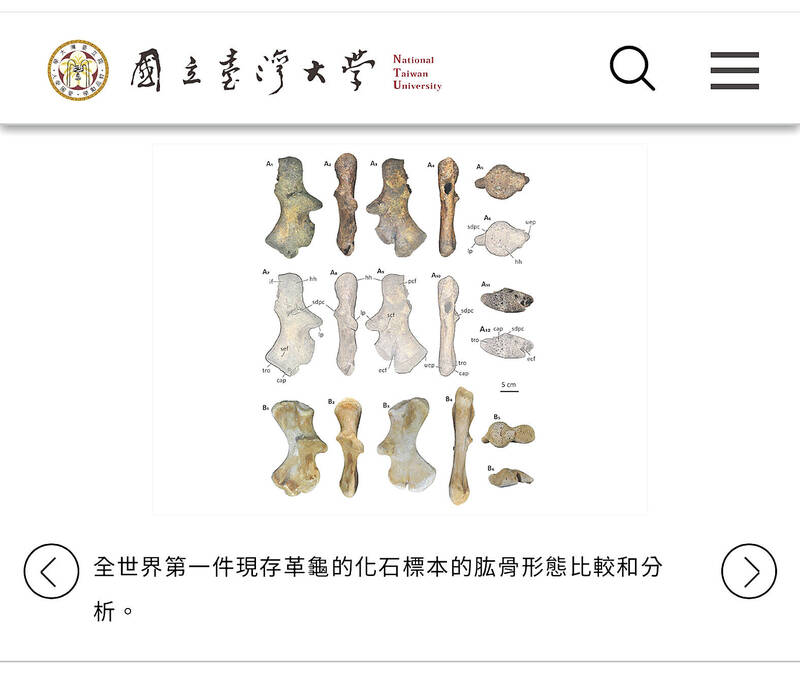
By Rachel Lin and William Hetherington / Staff reporter, with staff writerThe world’s first confirmed fossil of a modern leatherback sea turtle has been discovered off Taiwan, providing new clues about the species’ evolution.請繼續往下閱讀...A leatherback sea turtle, which can easily grow to more than 2m long, is the largest sea turtle species alive today. However, because they have a relatively soft shell, their fossils do not generally form well, limiting scientists’ understanding of the evolutionary history of modern leatherbacks.That might have changed with the analysis of a fossilized humerus found on the seabed between Taiwan and the Penghu Islands. National Taiwan University Department of Life Science and Institute of Ecology and Evolutionary Biology associate professor Tsai Cheng-hsiu (蔡政修) and doctoral candidate Liao Yi-ju (廖翊如) confirmed the bone belonged to a leatherback.The discovery is the first confirmed fossil of a modern leatherback found anywhere in the world and provides important clues about the species’ origins and evolution.Leatherbacks differ markedly from other living sea turtles. Tsai said all other living sea turtles belong to the family Cheloniidae, while leatherbacks belong to the family Dermochelyidae, which now contains only one living species: the leatherback.Unlike other sea turtles, leatherbacks do not have a hard shell. Instead, their outer covering has a leathery texture, giving rise to their English name, “leatherback sea turtle.”The fossilized humerus studied by Tsai and Liao was donated by Hou Li-jen (侯立仁), a retired professor from Tainan. It was discovered on the seabed in the same region where fossils of ancient pre-humans were found.After detailed comparisons and morphological analysis of the humerus, the researchers confirmed that it belonged to a leatherback.Their findings were published in June in the international journal Acta Palaeontologica Polonica.The fossil found off Taiwan provides clues about the evolution of leatherbacks. They have the broadest distribution of any living sea turtle, ranging from cold polar waters to the tropics. However, their nesting and feeding grounds are relatively limited.The waters around Taiwan do not host a major nesting or feeding area for leatherbacks. Important nearby nesting grounds include Indonesia, New Guinea and the Solomon Islands.Tsai said molecular data from modern leatherbacks suggest that the species might have originated in the Indo-Pacific, including waters around Taiwan. The discovery of the world’s first confirmed fossil of a modern leatherback in Taiwan supports this hypothesis about the species’ origins and evolution.The research team said fossil discoveries in Taiwan have demonstrated the importance and research value of the island’s paleontological record in understanding the origins and evolution of biodiversity.新聞來源:TAIPEI TIMES
评论 (0)