
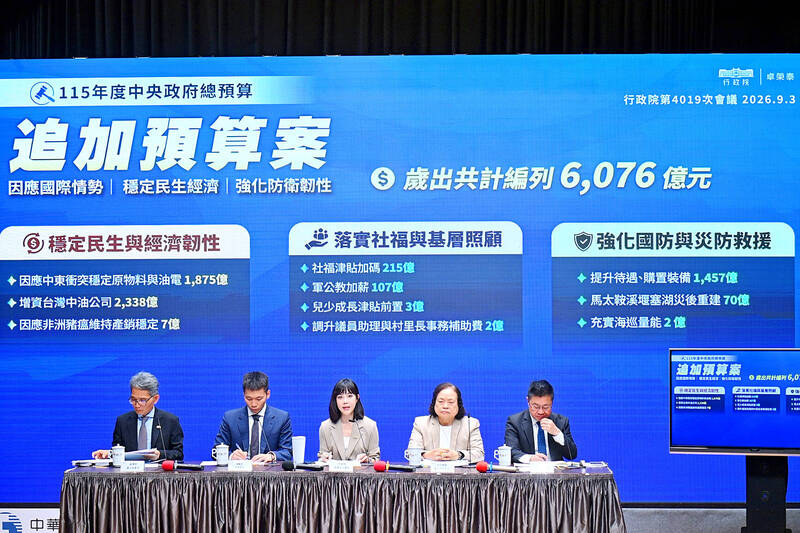
SUPPLEMENTRY FUNDING: The Cabinet’s proposal would provide CPC NT$233.8 billion to offset its losses, officials said, adding that its work is a national security issueBy Chung Li-hua and Jonathan Chin / Staff reporter, with staff writer請繼續往下閱讀...The Executive Yuan yesterday approved a record NT$607.63 billion (US$19.13 billion) supplementary budget, including NT$421.3 billion to stabilize the economy and NT$145.69 billion for weapons procurement.The budget was carefully planned to have no effect on fiscal planning or the national debt, officials told a news conference, calling on the legislature to support the bill.Measures to stabilize the economy amid conflict in the Strait of Hormuz accounted for the largest share of the budget, a Directorate-General of Budget, Accounting and Statistics (DGBAS) spokesperson told the news conference.The Cabinet would give state-run oil supplier CPC Corp, Taiwan (CPC, 台灣中油) a capital injection of NT$233.8 billion to offset its losses, the spokesperson said.CPC has spent heavily on building the nation’s liquefied natural gas (LNG) infrastructure and supply chains, as well as keeping fuel prices down despite a heated energy market, putting the company in the red, they said.The state-owned enterprise is key to enacting government plans to increase Taiwan’s energy resilience by securing LNG supplies, which justifies the heavy subsidies, they said.The government also proposed NT$187.5 billion to offset inflation stemming from ongoing conflicts in the Middle East, they said.That includes the costs of price controls on fuel, including household gas, and electricity, as well as subsidies for domestic air travel and taxi fuel, fertilizers, oil for the nation’s fishing fleet and harbor service fees, the spokesperson said.Vice Minister of Economic Affairs Lai Chien-hsin (賴建信) said that energy prices have surged amid the US-Iran conflict, which started in February, with crude oil reaching a record US$144 a barrel.Although crude oil prices fell in late June, CPC must enact measures to stabilize fuel prices while the fighting continues, Lai said, adding that Japan and South Korea have implemented similar policies.CPC’s intervention has kept fuel prices in Taiwan lower than any of its neighbors, he said.Without them, gasoline prices would have risen to NT$45 per liter at the pump, he said, adding that without the controls, monthly spending on gas by an average commuter would have been NT$1,000 to NT$2,000 more.The proposed budget would also fund CPC price controls that kept bottled LNG prices under NT$200 per bottle, which helped rein in inflation, Lai said.The government’s plan to keep household natural gas prices unchanged for the rest of this year would depend on the budget act passing, he said.Supporting CPC’s investment in LNG infrastructure and supply chains is a national security issue, as Taiwan needs to increase storage capacity for its strategic reserves, Lai added.Huang Wen-chi (黃文啟), director of the Ministry of National Defense’s Department of Strategic Planning, said the supplementary budget would also fund key capabilities that “Taiwanese armed forces should have had years ago.”The budget is to allocate funds for seven types of missiles, including high-altitude anti-ballistic missile air defense systems, coastal surveillance uncrewed aerial vehicles (UAVs), attack drones, uncrewed one-way strike boats and two classified projects, he said.The defense ministry considers the funding an imperative, as the military budget approved by the legislature funded only 10 out of 23 critical projects, he said.The funding shortfall has led to yawning capability gaps and negative effects on the armed forces’ ability to fight, which must urgently be addressed, he said.The defense ministry’s revised goal for building up a UAV fleet was to obtain 40,000 drones by next year, he said.Asked whether the defense ministry is authorized to ask the legislature to fund next year’s spending items in this fiscal year, DGBAS official Hsu Yung-yi (許永議) replied in the affirmative, citing Article 72 of the Budget Act (預算法).The article allows the Executive Yuan to propose budgets for special projects scheduled for implementation a year from the current fiscal year, which applies to the defense ministry’s requests, Hsu said.Asked whether the Executive Yuan would countersign the legislature’s version of the defense budget, Cabinet spokeswoman Michelle Lee (李慧芝) did not give a firm answer, but said that Taiwan cannot leave its defenses unattended.The Cabinet took receipt of the Legislative Yuan’s bill on Wednesday evening and is reviewing it before rendering a decision, Lee said.新聞來源:TAIPEI TIMES
评论 (0)