
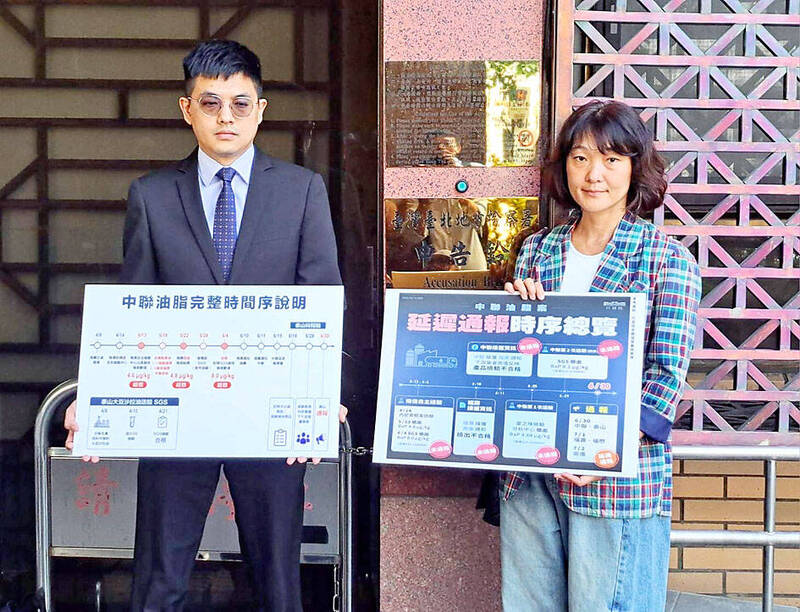
BAP ARGUMENTS: Lawyers said that responsibility would be determined by when information about abnormal BaP levels emerged and if it was promptly passed onBy Chang Wen-chuan and Sam Garcia / Staff reporter, with staff writer請繼續往下閱讀...Taisun Enterprise Co (泰山企業) yesterday filed a lawsuit against Central Union Oil Corp (中聯油脂) and three other companies, seeking NT$1 billion (US$31.71 million) in joint compensation over a food safety scandal involving Central Union-produced oil with excessive levels of the carcinogen benzo[a]pyrene (BaP).The Taichung District Prosecutors’ Office on Aug. 18 indicted Central Union Oil, Taisun, Fwusow Industry Co (福壽實業) and Formosa Oilseed Processing Co (福懋油脂), as well as individuals, with the charges ranging from contraventions of the Act Governing Food Safety and Sanitation (食品安全衛生管理法) to forgery and fraud related to alleged distribution of tainted cooking oil.The key issue to determine responsibility is when the information about abnormal BaP levels emerged and whether it was promptly passed on, Taisun lawyer Chen Cheng-hsi (陳政熙) said.Namchow Oil and Fat Co (南僑油脂事業股份) received three test reports on May 13, May 22 and June 4 showing excessive BaP levels, but only privately notified Fwusow, Chen said, adding that neither company fulfilled its obligation to promptly report the findings to authorities.Fwusow also failed to promptly notify authorities after learning of abnormal test results on May 18, he added.Comparing the information in the indictment with Namchow’s public statements shows significant differences in when the companies obtained information, how much they knew and how they responded, he said.The firms’ failure to report the problem meant the tainted oil was not identified and taken off shelves for two months, the lawyer said.Companies, including Taisun, continued to use the oil without knowing there was a problem, later leading to major losses from product recalls, inventory disposal, consumer compensation, reduced profits and damage to their reputations, he said, adding that Taisun’s losses were about NT$1 billion.Taisun initially believed that as long as a product bearing its name was on the market, it had a responsibility to consumers, Taisun marketing vice president Niu An-tse (鈕安澤) said.However, while handling consumer complaints and during the confidential investigation, the firm did not know when other companies had discovered problems in their supply chains, Niu said.After the indictment was released, Taisun compared it with statements from Fwusow and other companies and news reports, as well as its own test results from April and May, and filed a lawsuit against the companies to clarify responsibility, she said.Taisun received the same Central Union Oil soybean oil as Namchow on April 8 and 9, had its own products tested by Switzerland-based SGS on April 10 and received passing results on April 21, giving it no reason to believe its products were unsafe, the company said.If Namchow had disclosed the abnormal test results when they were first detected in the middle of May, Central Union Oil and other companies in the supply chain could have begun tracing the source, conducting additional tests and managing the risks, it said.Mid-May to mid-June was a crucial period for containing the problem, but the delayed sharing of information postponed supply-chain tracing and risk controls, worsening the company’s loses, Taisun added.The courts should determine the responsibility of Central Union Oil, Fwusow, Namchow and Formosa Oilseed based on when they learned of the problem and how promptly they reported it, Taisun said.Additional reporting by CNA新聞來源:TAIPEI TIMES
评论 (0)